Ahpra registration PHY0002298174
How these guides are written and reviewed →
A cough is called chronic when it lasts more than about eight weeks. Common causes include asthma, reflux, post-nasal drip, smoking, certain blood-pressure medicines and lingering irritation after an infection. Working out the cause usually means a careful history, an examination and a few tests. Treatment is aimed at whatever is driving it, and a stubborn cough can often be settled with breathing and speech-therapy techniques. This page covers the causes, the assessment and what helps.
Definition
Cough is the most common respiratory symptom presenting to healthcare providers in Australia and is classified by duration into three categories: acute (less than 3 weeks, usually infective), subacute (3–8 weeks, often post-infectious), and chronic (more than 8 weeks). Chronic cough affects an estimated 5–10% of Australian adults and accounts for a disproportionate burden of specialist respiratory and ear, nose and throat (ENT) referrals.1
Refractory chronic cough (RCC) is defined as chronic cough that persists despite investigation and treatment of identified contributing conditions. Unexplained chronic cough (UCC) is chronic cough for which no cause is identified after thorough clinical investigation. Both are now understood as manifestations of a cough hypersensitivity syndrome — a neurological condition in which central and peripheral sensitisation of the cough reflex lowers the threshold for cough triggering, so that stimuli that would not normally produce cough (cold air, perfume, speaking, laughing, changes in temperature) now do so reliably. This reframing has transformed management: treating the sensitised nervous system, rather than searching indefinitely for a peripheral cause, is the modern therapeutic approach to RCC/UCC.
Pathophysiology
Coughing is a reflex. Nerve endings in the airways (fast-adapting mechanoreceptors, slowly-adapting receptors and C-fibres) send signals along the vagus nerve to a cough centre in the brainstem. The higher brain can also dial the reflex up or down, which is why a cough can be partly suppressed on purpose. Cough may be triggered by mechanical stimulation, chemical stimulation (bradykinin, capsaicin, acid), and changes in airway osmolarity.2
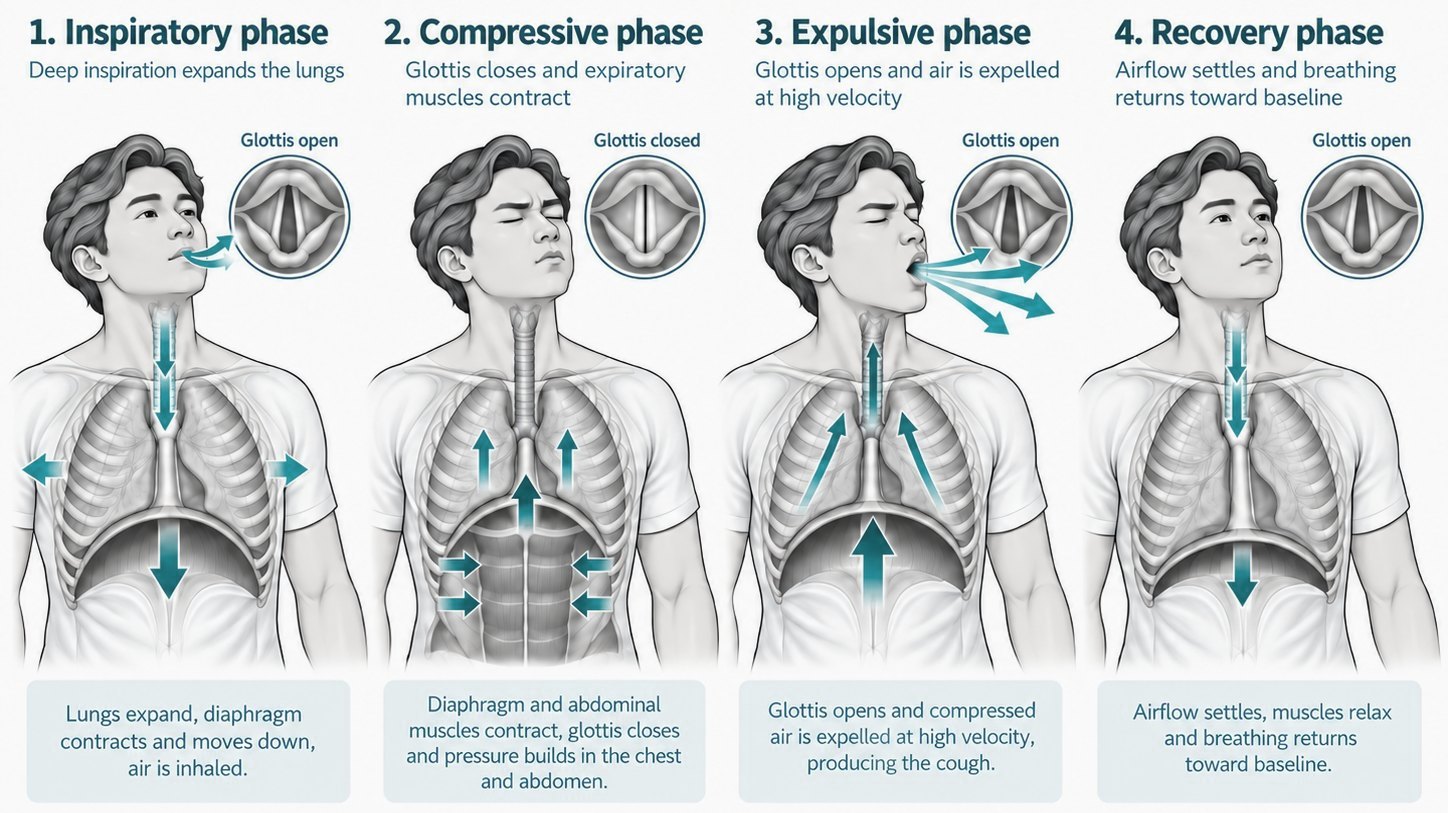
Peripheral sensitisation occurs when airway receptors become more responsive following tissue injury, inflammation, acid exposure, or viral infection. This is the mechanism in post-infectious cough, asthmatic cough, and GORD-associated cough.
Central sensitisation — the defining feature of cough hypersensitivity syndrome — involves altered central processing: increased gain of the afferent signal, reduced descending inhibition, and allodynia (cough triggered by normally non-tussigenic stimuli). Once established, central sensitisation can perpetuate cough independent of ongoing peripheral disease, explaining why treating GORD, asthma, and rhinitis may resolve the initial trigger without resolving the cough.
Female sex is a major risk factor: oestrogenic upregulation of cough reflex sensitivity explains the 2:1 female predominance of RCC/UCC. Post-viral neuronal injury — demonstrated following influenza, SARS-CoV-2, and other respiratory viruses — is an increasingly recognised trigger for de novo cough hypersensitivity. Psychological factors modulate cough through top-down effects on central inhibition; this does not imply psychogenic aetiology but means that cognitive and behavioural approaches are valid neurologically-grounded treatments.
Co-morbidities
Common co-morbidities relevant to chronic cough include: asthma, rhinitis, chronic rhinosinusitis, GORD, laryngopharyngeal reflux, anxiety and depression, inducible laryngeal obstruction, chronic obstructive pulmonary disease (COPD), bronchiectasis, and post-infectious syndromes including long COVID.
Prevalence
Chronic cough affects approximately 5–10% of Australian adults; prevalence is higher in women, in older adults, and in smokers. It is consistently among the most common reasons for primary care consultation and specialist referral.
Causes and triggers
Upper airway cough syndrome (UACS):
The most common identified cause of chronic cough in population-based studies. Encompasses allergic rhinitis, non-allergic rhinitis, chronic rhinosinusitis, post-nasal drip, and nasal polyposis. The cough is typically posterior in origin, associated with throat clearing, a sensation of mucus dripping from the posterior nares into the throat, and nasal symptoms. Diagnosis is largely clinical; response to empirical intranasal corticosteroid is both diagnostic and therapeutic.
Asthma and cough-variant asthma:
Asthma is the second most common cause of chronic cough and may present with cough as the sole or dominant symptom (cough-variant asthma), without wheeze or dyspnoea. Triggers include cold air, exercise, and aeroallergens. Spirometry may be normal between episodes; fractional exhaled nitric oxide (FeNO) is often elevated; bronchial provocation testing (mannitol or methacholine challenge) confirms airway hyperresponsiveness. Excellent, often complete, response to inhaled corticosteroids (ICS) is both diagnostic and therapeutic.
Non-asthmatic eosinophilic bronchitis (NAEB):
Airway eosinophilia (sputum eosinophils >3%) without the bronchial hyperresponsiveness of asthma. Often presents as a persistent dry cough triggered by cold air or exercise, without wheeze. Elevated FeNO is supportive. Excellent response to ICS.
Gastro-oesophageal and laryngopharyngeal reflux:
GORD is a common but often over-attributed cause of chronic cough. The relationship is bidirectional — cough generates reflux via transient lower oesophageal sphincter relaxation. Laryngopharyngeal reflux (LPR), in which acid or non-acid material reaches the larynx and pharynx, may produce laryngeal irritation, throat-clearing, dysphonia, and cough in the absence of heartburn. 24-hour pH-impedance monitoring is the diagnostic gold standard. The evidence that proton pump inhibitors (PPIs) reduce cough in the absence of confirmed reflux is modest at best (several randomised controlled trials show no benefit over placebo); empirical PPI therapy should be time-limited (4–8 weeks) with objective response assessment and should not be continued indefinitely without documented benefit.
ACE inhibitor cough:
Affects 5–15% of patients commenced on any ACE inhibitor, regardless of dose. Caused by accumulation of bradykinin and substance P in the airways — molecules normally degraded by ACE. Typically begins within days to weeks of starting therapy but may develop after years of use. Complete resolution within days to weeks of substituting an ARB. ACE inhibitor use must be identified and the medication ceased before any other cause of chronic cough is investigated — it is the most commonly missed, most easily treated, and most frequently overlooked cause of chronic cough in clinical practice.
COPD and chronic bronchitis:
Chronic productive cough for more than 3 months in two or more consecutive years in the absence of other explanation defines chronic bronchitis. It is the dominant symptom of the mucus-hypersecretion COPD phenotype. Management centres on smoking cessation, mucolytics (carbocisteine, N-acetylcysteine), airway clearance physiotherapy, and optimisation of inhaled therapy.
Bronchiectasis:
Daily productive cough, often purulent, with haemoptysis and recurrent respiratory infections. Airway clearance is the cornerstone of management. See the Bronchiectasis document.
Interstitial lung disease:
Dry, persistent, often distressing cough occurs in idiopathic pulmonary fibrosis (IPF) and many other ILDs, frequently disproportionate to the degree of physiological impairment and poorly responsive to anti-fibrotic therapy. Management of ILD cough is challenging and is addressed in the IPF document.
Post-infectious and post-viral cough:
A common cause of subacute cough (3–8 weeks after respiratory infection). Pertussis (whooping cough) produces a characteristic paroxysmal, high-pitched "100-day" cough with inspiratory whoop, post-tussive emesis, and intense cough paroxysms; it occurs in unimmunised adults and is frequently missed or diagnosed late. PCR swab within 3–4 weeks of onset is diagnostic; macrolide treatment reduces infectivity. Post-viral sensory neuropathy following influenza, SARS-CoV-2, and other respiratory viruses can trigger refractory cough through persistent vagal afferent sensitisation.
Lung cancer:
Any new or changed cough in a person over 40 with a current or former smoking history warrants a chest X-ray to exclude endobronchial malignancy. Haemoptysis at any volume in a patient with a smoking history requires urgent chest imaging and specialist review. See the Lung Cancer document.
Inducible laryngeal obstruction (ILO):
Paradoxical adduction of the vocal cords or supraglottic structures during inspiration produces episodic cough, stridor, and dyspnoea. Cough and dysphonia are prominent features. See the Dysfunctional Breathing and ILO document.
Refractory and unexplained chronic cough (cough hypersensitivity syndrome):
A diagnosis of exclusion reached after systematic investigation and time-limited empirical treatment trials have failed to identify or control a cause. Characterised by a low-threshold cough triggered by minor stimuli (perfume, cold air, talking, exercise, laughing, changes in temperature), an urge-to-cough sensation preceding each episode, and often a tickling or laryngeal irritation sensation. Predominantly affects middle-aged women. Treatment targets central neurological sensitisation rather than peripheral airway pathology.
Diagnosis
Why Diagnosis Matters
A systematic approach identifies a treatable cause in the majority of patients. The most common missed diagnosis is ACE inhibitor cough; the most common over-attributed cause is GORD; the most common delayed diagnosis is cough-variant asthma in patients without wheeze. Accurate diagnosis avoids unnecessary long-term PPI use and enables targeted treatment, substantially reducing cough frequency and quality of life burden.
How is it Diagnosed?
Clinical history: Duration and onset (gradual vs following an acute respiratory illness), character (dry and hacking, or productive; paroxysmal or continuous), timing (nocturnal, on waking, post-prandial, exercise-induced), triggers (cold air, perfume, talking, laughing, exercise, eating, certain foods, posture), associated symptoms (nasal symptoms or post-nasal drip, heartburn or reflux, wheeze, haemoptysis, weight loss, voice change), functional impact, occupation, smoking history and pack-year quantification, all current medications with particular attention to ACE inhibitors, recent respiratory infections.3
Outcome Measures
Leicester Cough Questionnaire (LCQ): A 19-item patient-completed questionnaire across three domains: physical (e.g. "my cough has made me feel exhausted"), psychological (e.g. "I have felt embarrassed by my cough"), and social (e.g. "my cough has interfered with my work"). Each domain is scored 1–7 (7 = best); total score range 3–21. The minimal clinically important difference (MCID) is 1.3 units. The LCQ is the most widely validated health-related quality of life measure for chronic cough, used in Australian and international clinical trials, and appropriate for routine clinical monitoring.
Cough Visual Analogue Scale (VAS): A 100 mm horizontal scale anchored by "no cough" and "worst cough imaginable." Simple, immediately responsive, and practical at every clinic visit for tracking change.
Hull Airways Reflux Questionnaire (HARQ): A 14-item questionnaire designed specifically to identify extra-oesophageal reflux as a contributor to chronic cough and throat symptoms. Scores >13 suggest clinically relevant reflux contribution.
Cough Severity Diary (CSD): Patient-reported daily ratings of cough frequency and severity across multiple days; captures day-to-day variability and week-to-week trends.
FeNO (fractional exhaled nitric oxide): Values >25 ppb suggest type-2 eosinophilic airway inflammation; values >50 ppb are strongly supportive of eosinophilic asthma or NAEB. A point-of-care test rapidly distinguishing eosinophilic from non-eosinophilic cough and guiding ICS prescribing.
24-hour ambulatory cough monitoring: Objective measurement of cough frequency using validated acoustic recording devices (e.g. Leicester Cough Monitor, Vitalograph). Available in specialist centres; provides objective endpoints for clinical trials and challenging cases where subjective reporting is questioned.
Investigations
Systematic stepwise approach:
- Chest X-ray — exclude malignancy, pulmonary infiltrate, cardiac enlargement, and pleural disease
- Confirm medication list and cease ACE inhibitor with ARB substitution; document whether cough resolves within 4–8 weeks
- Spirometry with bronchodilator reversibility and FeNO — screen for asthma and eosinophilic bronchitis; if normal but asthma suspected, proceed to bronchial provocation testing
- Intranasal corticosteroid trial for 4–6 weeks — diagnostic and therapeutic for UACS
- PPI bd for 4–8 weeks — empirical trial for GORD/LPR; document objective response
- high-resolution computed tomography (HRCT) chest — if chest X-ray is abnormal, haemoptysis present, clinical concern for ILD or bronchiectasis, or unexplained abnormalities
- Sinus CT — if rhinosinusitis, nasal polyposis, or upper airway symptoms not responding to empirical treatment
- ENT assessment and flexible nasendoscopy — if ILO, laryngopharyngeal disease, or upper airway pathology suspected
- 24-hour pH-impedance monitoring — gold standard for GORD/LPR assessment; indicated when empirical PPI has failed and reflux is still suspected
- Induced sputum eosinophil count — NAEB diagnosis in specialist centres where FeNO is equivocal
- Pertussis PCR or serology — when paroxysmal cough, inspiratory whoop, or post-tussive emesis in adults
Management
Treatment Goals
To identify and treat the cause where one is found; to reduce cough frequency and severity where full resolution is not achievable; and to restore quality of life by managing the psychosocial, physical, and sleep-disrupting consequences of chronic cough.
Condition-Specific Treatment
UACS: Intranasal corticosteroid spray once daily (e.g. mometasone, fluticasone, budesonide), saline nasal irrigation (high-volume low-pressure rinse), and a first-generation antihistamine (e.g. promethazine or chlorphenamine, 25 mg nocte — the sedating antihistamines have an additional anticholinergic anti-secretory effect not shared by second-generation agents). ENT referral for chronic rhinosinusitis with nasal polyposis refractory to nasal corticosteroid.4
Asthma and NAEB: ICS at moderate dose (equivalent to fluticasone 250–500 mcg bd) produces excellent response, typically resolving cough within 4–8 weeks. A short course of oral prednisolone (25–30 mg daily for 5–7 days) may be appropriate where FeNO is high and diagnostic confirmation is sought.
GORD/LPR: High-dose PPI bd for 4–8 weeks, dietary modifications (avoid meals within 3 hours of lying flat, reduce fatty and spicy foods, caffeine, alcohol, and carbonated drinks), weight management where obesity contributes, elevation of the head of the bed. If reflux is confirmed on pH-impedance but PPI response is inadequate, baclofen or alginates may be added. Surgical referral for refractory confirmed GORD.
ACE inhibitor: Substitute an ARB (perindopril → irbesartan, ramipril → telmisartan, lisinopril → candesartan). Cough typically resolves within 1–4 weeks; occasionally takes up to 8 weeks. Document resolution clearly in the clinical record.
Post-infectious cough: Intranasal corticosteroid and ipratropium nasal spray (Otrivin nasal spray or Atrovent nasal) may hasten resolution of post-nasal drip component. Pertussis: macrolide treatment (azithromycin 500 mg daily for 3 days, or doxycycline 100 mg bd for 7 days in macrolide-intolerant patients) reduces infectivity in the contagious phase and may modestly shorten the clinical course.
COPD and chronic bronchitis: Smoking cessation is the single most effective intervention. Mucolytics (carbocisteine 750 mg tds reducing to 1.5 g/day maintenance, or N-acetylcysteine 600 mg bd), airway clearance physiotherapy, and optimisation of inhaled therapy.
ILD-associated cough: Thalidomide at low dose (50–100 mg nocte) has demonstrated efficacy for IPF-associated cough in one RCT (Horton et al.) and is occasionally used under specialist supervision. Low-dose opioids for refractory cough in advanced disease; antifibrotic and corticosteroid therapy optimisation. See IPF document.
Refractory and Unexplained Chronic Cough (Cough Hypersensitivity Syndrome)
When cough persists despite the above sequence, or no cause is found after thorough investigation, cough hypersensitivity is the working diagnosis. Treatment targets central neurological sensitisation:5
Cough suppression therapy (physiotherapy and speech pathology): The most evidence-based, durable, and non-pharmacological treatment for RCC/UCC. Delivered across 4–6 sessions by a physiotherapist and/or speech pathologist with training in cough control. Components include: education (explaining the cough-hypersensitivity model validates the patient's experience and reduces catastrophising), voluntary cough suppression techniques (breathing through the urge-to-cough, swallowing, sipping cold water), throat-clearing elimination (throat clearing perpetuates laryngeal irritation and reinforces the urge), laryngeal hygiene (adequate hydration, humidification, avoidance of triggers), and controlled nasal breathing. Response rates of 60–70% for clinically meaningful reduction are reported in published series. Should be offered to all patients with RCC/UCC before or alongside pharmacotherapy.
Gabapentin: 100–300 mg at night, titrated to 300 mg tds as tolerated. Reduces cough frequency through gabapentinoid modulation of sensitised vagal afferents and central processing. Evidence from a randomised controlled trial (Ryan et al., 2012): NNT approximately 3 for ≥30% cough reduction. Sedation and dizziness limit dose escalation; effective doses are often well below the maximum tolerated epilepsy dose. Dose reduction required in renal impairment (CrCl <30 mL/min).
Pregabalin: Similar gabapentinoid mechanism; may be better tolerated in some patients. The LANCET trial (Gibson et al., 2017) combined pregabalin with cough control therapy and demonstrated significantly better outcomes than either alone.
Gefapixant (Lyfnua, 45 mg bd): A selective P2X3 receptor antagonist that reduces afferent cough signalling from ATP-sensitive airway C-fibres, reducing both the cough reflex sensitivity and the urge-to-cough. PBS-listed in Australia for adults with RCC or UCC where cough has persisted ≥12 months and prior treatments have been ineffective. The COUGH-1 and COUGH-2 phase III trials demonstrated significant reductions in 24-hour cough frequency (approximately 18–25% greater reduction than placebo at 12 and 24 weeks). Principal side effect: taste disturbance (dysgeusia) — a metallic, bitter, or reduced taste affecting approximately 60–70% of patients in trials. The effect is typically mild to moderate in severity, affects specific foods and beverages, does not affect smell, and resolves within weeks of ceasing the drug. Patients should be counselled about dysgeusia before prescribing, as it is the primary reason for discontinuation. Pharmaceutical Benefits Scheme (PBS) authority prescribing requires documentation of prior treatment failure; a baseline LCQ and objective cough measures are recommended.
Amitriptyline 10–25 mg nocte: Widely used in clinical practice for neurogenic and refractory cough, particularly where concurrent depression, sleep disturbance, or neuropathic features are present. Modest observational evidence; anticholinergic side effects limit use in older adults.
Baclofen 10–20 mg tds: GABA-B agonist; reduces transient lower oesophageal sphincter relaxations (relevant in confirmed GORD-associated cough) and has weak evidence for unexplained cough. May cause somnolence and dizziness.
Low-dose opioids: Codeine 30 mg bd or morphine have established cough suppressant activity and are appropriate where rapid response is needed, in palliative settings, and as a bridge while definitive neurogenic treatments are titrated.
Palliative Cough
In advanced lung cancer, mesothelioma, and end-stage respiratory disease, cough is frequently one of the most distressing and disabling symptoms. Management priorities:
- Low-dose oral morphine (2.5–5 mg 4-hourly or modified-release 10 mg bd) — the most effective agent and the Australian standard for palliative cough
- Nebulised 2% lignocaine (lidocaine) 5 mL bd–qid — used in specialist palliative care units; short-acting (30–90 minutes), requires supervision for bronchospasm risk on first dose, contraindicated in known lidocaine allergy
- Methadone has the longest duration of action among opioids used for cough and is used in specialist palliative care
- Benzonatate (not widely available in Australia)
Medications
Key agents summarised above. See the condition-specific sections and Pharmacological Reference Tables for detailed drug information.
Multi-system Manifestations
Cough Syncope
Sustained high-intrathoracic-pressure cough paroxysms reduce venous return and cardiac output sufficiently to produce pre-syncope or syncope. More common in COPD with high intrinsic PEEP and in patients with chronic severe cough. Cough syncope with injury warrants medical review and driving assessment per Austroads guidance.
Urinary Incontinence
Stress urinary incontinence from chronic cough is highly prevalent, affecting the majority of women and a significant proportion of men with daily chronic cough, and is consistently under-reported due to embarrassment. It represents a major quality-of-life impact and should be actively enquired about at every clinical encounter. Pelvic floor physiotherapy (supervised with biofeedback where available) and bladder training are first-line interventions and should be offered routinely and proactively to patients with chronic productive cough, cough hypersensitivity, or COPD.
Musculoskeletal Complications
Rib fractures from sustained paroxysmal cough occur with background osteoporosis (particularly in patients on long-term corticosteroids for asthma or COPD) and warrant imaging and orthopaedic review. Thoracic and cervical pain from accessory muscle overuse during cough paroxysms is common. Headache and haemoptysis occur from the pressure-related effects of paroxysmal coughing.
Sleep Disruption
Nocturnal cough is a major cause of sleep fragmentation, partner disturbance, daytime fatigue, and impaired quality of life. Specific enquiry should be made about night-time cough at every clinical review. Strategies include: pre-bed airway clearance for productive cough, humidification, head of bed elevation for reflux-associated cough, timing of inhaled medications to maximise overnight coverage, and where appropriate, nocturnal use of cough suppression techniques.
Voice and Laryngeal Effects
Chronic cough produces mechanical trauma to the vocal cords with dysphonia, vocal cord oedema, and inflammatory changes that in turn lower the cough threshold through laryngeal sensitisation — a self-perpetuating mechanism. Voice rest during acute exacerbations, adequate hydration, avoidance of throat clearing, and speech pathology input for laryngeal hygiene all reduce this cycle.
Psychological and Social Impact
Chronic cough causes social embarrassment (public coughing during the COVID-19 pandemic had particular impact), avoidance of social settings, interruption of sleep, and substantial anxiety. Patients with RCC/UCC are frequently dismissed as anxious or neurotic before the cough hypersensitivity model is applied; this diagnostic journey increases distress. Validation of the diagnosis, clear explanation of the neurological mechanism, and psychological support where indicated are important elements of care.
Living with chronic cough
Self-Management
Trigger identification (cough diary), avoidance strategies, adequate hydration (target ≥1.5–2 L/day — reduces laryngeal surface liquid dehydration), humidification of the home environment in dry climates, avoidance of throat-clearing and habitual hard coughing, and regular practice of cough suppression techniques learned in therapy.
Prognosis
With accurate diagnosis and targeted treatment, the majority of patients with an identified cause (UACS, asthma/NAEB, ACE inhibitor, GORD) achieve significant improvement. For RCC/UCC, cough suppression therapy alone achieves ≥50% reduction in cough frequency and LCQ improvement in 60–70% of patients. Gabapentin, pregabalin, and gefapixant provide additional benefit in those who do not respond to behavioural approaches alone. Complete resolution is achievable in a meaningful proportion; sustained management strategies are required for the remainder. Prognosis is best predicted by engagement with cough control therapy and avoidance of perpetuating behaviours (throat clearing, hard coughing).
Resources
Lung Foundation Australia; National Prescribing Service (NPS MedicineWise) — gefapixant PBS listing information; local physiotherapy and speech pathology referral for cough suppression therapy; Asthma Australia; pertussis information via Queensland Health Communicable Diseases Unit.
References & evidence base
- Irwin RS, French CL, Chang AB, Altman KW. Classification of cough as a symptom in adults and management algorithms: CHEST guideline and expert panel report. Chest 2018;153(1):196–209.
- Chung KF, McGarvey L, Song WJ, et al. Cough hypersensitivity and chronic cough. Nat Rev Dis Primers 2022;8(1):45.
- Smith JA, Woodcock A. Chronic cough. N Engl J Med 2016;375(16):1544–1551.
- Morice AH, Millqvist E, Bieksiene K, et al. ERS guidelines on the diagnosis and treatment of chronic cough in adults and children. Eur Respir J 2020;55(1):1901136.
- Chamberlain Mitchell SAF, Garrod R, Clark L, et al. Physiotherapy, and speech and language therapy intervention for patients with refractory chronic cough: a multicentre randomised control trial. Thorax 2017;72(2):129–136.
References are numbered in citation order (Vancouver/BMJ style) and were current at the time of writing. Guidelines are living documents — verify against the latest version before clinical use.
Clearing mucus well is a skill rather than a machine. We match a technique to your lungs and your routine, then coach it until you can do it at home on a bad morning.
Corrections: If something on this page is wrong, out of date or unclear, we want to know. Email reception@inspireclinic.au with the page name and what you believe is incorrect. Substantive corrections are made promptly, and the guide’s version and last-updated date are changed to reflect it.