Ahpra registration PHY0002298174
How these guides are written and reviewed →
An incentive spirometer is the small plastic breathing device often handed out after an operation. You breathe in slowly and deeply through the mouthpiece and watch a piston or a ball rise, which gives you a target to aim for. The point is not the device but the breath: slow and deep, then hold it for two or three seconds. Breathing in fast enough to slam the ball to the top is the most common mistake and does not help. Research shows the device adds little for most people after surgery — sitting out of bed and walking help more — but it is genuinely valuable for people admitted with sickle cell chest or back pain, and useful as a reminder between physiotherapy sessions.
What incentive spirometry is
An incentive spirometer is a hand-held plastic device that gives visual feedback during a slow, deep breath in. The patient inhales through a mouthpiece and either raises a piston to a marked volume (a volume-oriented device) or lifts one or more balls in a chamber by generating flow (a flow-oriented device). It is one of the most widely distributed pieces of equipment in hospital medicine, and one of the most consistently misused.
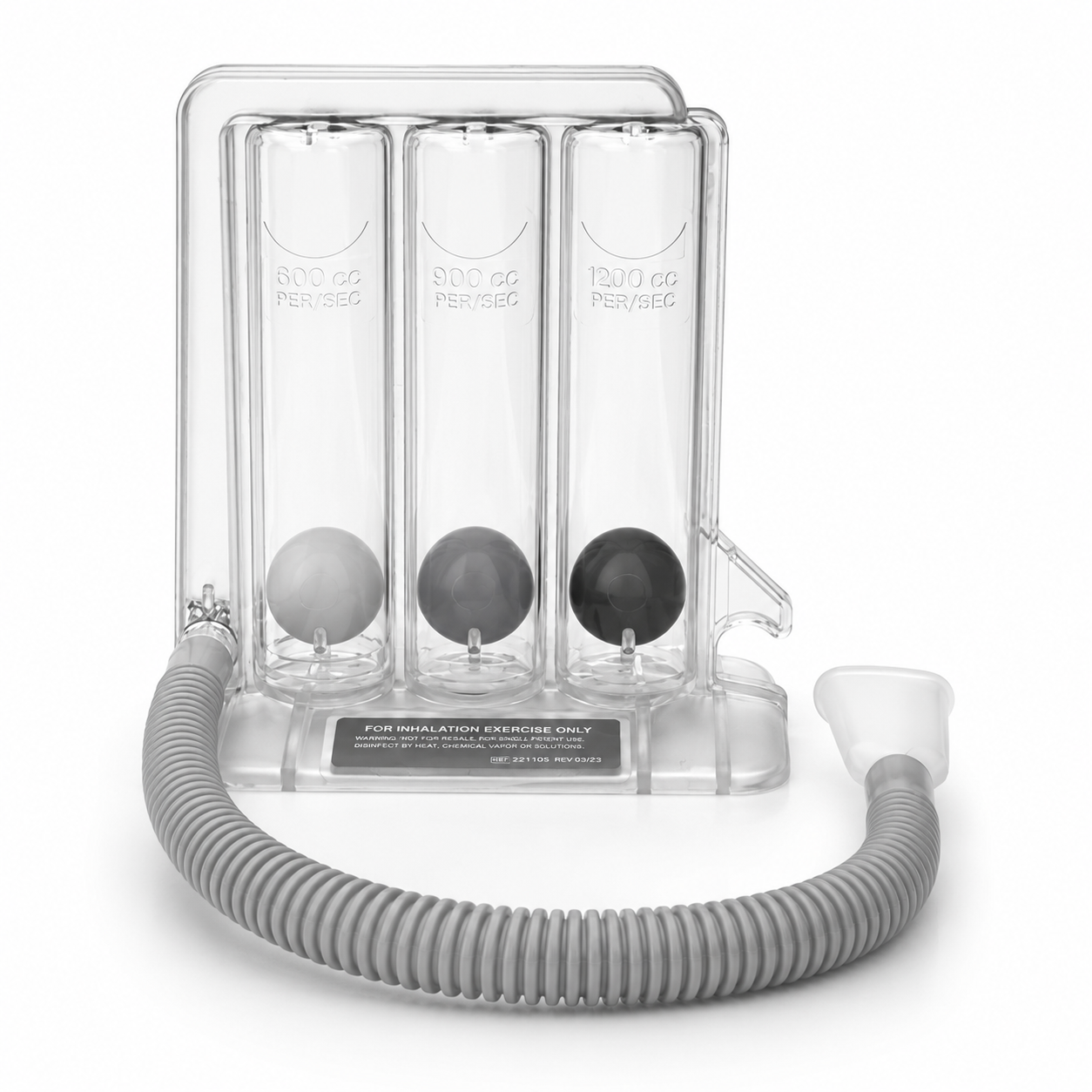
The device does nothing by itself. The therapy is a sustained maximal inspiration — a slow breath to near total lung capacity, held for 2–3 seconds. The spirometer only provides a target and a record.
The physiological rationale
After anaesthesia and abdominal or thoracic surgery, functional residual capacity falls by 20–30%, the diaphragm is dysfunctional, and pain and sedation abolish the periodic sighs that normally reinflate dependent lung. The result is atelectasis, which appears within minutes of induction and persists for days.
A sustained maximal inspiration generates a large negative transpulmonary pressure gradient and holds it, which recruits collapsed alveoli more effectively than a rapid breath of the same volume — collateral ventilation through the pores of Kohn and channels of Lambert takes time to equilibrate. The physiology is sound. Whether a plastic device is required to achieve it is a different question, and it is the question the evidence has repeatedly asked.
How to use it properly
Most of the failure of incentive spirometry in practice is failure of technique and dose, not of concept.
- Sit upright — high sitting or out of bed in a chair. Supine use halves the effect and should be avoided unless unavoidable.
- Treat the pain first. An unmedicated post-operative patient cannot take a maximal breath, and no device changes that. Time the session to peak analgesia.
- Exhale normally, then seal the lips around the mouthpiece.
- Inhale slowly and deeply — the aim is the deepest possible breath, not the fastest. On flow devices, raise the ball just enough to hold it steady in the target zone; sucking hard enough to slam it to the top is the classic error and produces a fast, shallow, useless breath.
- Hold for 2–3 seconds at the top. This is the part patients most often omit and the part that matters most.
- Exhale gently, rest for several normal breaths, and repeat. Rushing repetitions causes dizziness from hypocapnia.
- Dose: commonly 10 breaths every hour while awake. Record the best volume achieved and set the next target from it.
- Follow with a huff or supported cough if there are secretions, splinting the wound with a folded towel or pillow.
Slow and deep, then hold. If a patient can make the device roar, they are doing it wrong. Watch a full set at least once before leaving the device at the bedside — an unobserved incentive spirometer on a locker is a prop, not a treatment.
What the evidence actually shows
Incentive spirometry has been studied more than almost any other post-operative respiratory intervention, and the findings have been remarkably consistent for four decades.
After cardiac surgery
Cochrane review of incentive spirometry after coronary artery bypass grafting found no evidence of benefit over other lung-expansion techniques — deep breathing exercises, positive expiratory pressure or continuous positive airway pressure (CPAP) — for pulmonary complications, and no advantage in arterial oxygenation or lung function.1 The reviewers explicitly cautioned against its use as the sole prophylactic strategy.
After upper abdominal surgery
A second Cochrane review found low-quality evidence and no clear benefit for incentive spirometry in preventing post-operative pulmonary complications after upper abdominal surgery, and no advantage over deep breathing exercises alone.2 Trials were small, mostly unblinded, inconsistently reported adherence, and rarely verified that patients were performing the manoeuvre correctly.
Where it clearly does work: sickle cell disease
In children and adults admitted with sickle cell chest or back pain, a randomised controlled trial of incentive spirometry — ten maximal inspirations every two hours while awake — reduced the incidence of acute chest syndrome from 8 of 19 control episodes to 1 of 19 treated episodes.3 This remains one of the most convincing preventive results in respiratory physiotherapy, and it is the indication in which incentive spirometry should be actively championed rather than defended.
Where the effect really lies: education and mobilisation
The LIPPSMAck-POP trial randomised over 400 patients before major upper abdominal surgery to a single 30-minute preoperative physiotherapy education and breathing-exercise session or to an information booklet. The intervention halved the incidence of post-operative pulmonary complications, with a number needed to treat of seven.4 The active ingredient was teaching the patient what to do and why, before the operation — not the device. Bundled care approaches such as ICOUGH, which combine incentive spirometry with coughing, oral care, early ambulation, head-of-bed elevation and education, have reported reductions in pneumonia, but the bundle design makes the contribution of any single element unrecoverable.5
Where incentive spirometry still has a place
- Sickle cell disease during a painful crisis affecting the chest or back — the strongest indication, and one that is often missed.
- As a cue between physiotherapy sessions, in a patient who has been taught properly and who is not yet mobilising well. It provides structure, a target and a record for the nursing staff.
- Where a visual target genuinely helps — patients who cannot reliably reproduce a deep breath on instruction, including some with cognitive impairment or language barriers.
- Within a bundle that includes education, analgesia, sitting out and early mobilisation — on the understanding that the other components carry most of the effect.
- Objective monitoring — the achieved volume is a simple, reproducible number that trends usefully across post-operative days.
Where it does not belong
- As a substitute for getting the patient out of bed. Mobilisation outperforms every device-based lung-expansion technique studied, and a patient sitting in a chair breathing normally is doing more for their lungs than the same patient supine with a spirometer.
- Routinely after uncomplicated surgery in a low-risk, mobilising patient — no benefit, and it consumes staff attention that could go to the high-risk patient down the corridor.
- Handed out without teaching. A device issued without observed practice is not a treatment.
- As airway clearance. It is a lung-expansion therapy. Secretion clearance requires expiratory flow — huffing, cough, or a dedicated technique.
- In place of non-invasive ventilation (NIV) or continuous positive airway pressure (CPAP) where those are indicated for hypoxaemic respiratory failure.
Cautions
| Situation | Consideration |
|---|---|
| Inability to follow instructions or seal the lips | The therapy cannot be delivered; choose another technique |
| Vital capacity below about 10 mL/kg, or inspiratory capacity under ~1 L | Unlikely to generate a useful sustained inspiration; consider positive-pressure adjuncts |
| Untreated pneumothorax, recent bullectomy or bronchopleural fistula | Discuss with the surgical team before any lung-expansion therapy |
| Dizziness or paraesthesia during use | Repetitions too rapid — hypocapnia. Slow down and rest between breaths |
| Uncontrolled pain | Treat the pain; do not persist with an ineffective manoeuvre |
| Infection control | Single patient use; never share, and clean and store dry between sessions |
| Fatigue | Stop when the achieved volume falls consistently below the earlier best in the same session |
What this changes in practice
The physiotherapist's job with incentive spirometry is mostly to prevent it from being used as a substitute for physiotherapy. That means four rules.
Risk-stratify. Identify the patients whose post-operative pulmonary complication risk is genuinely high — upper abdominal or thoracic incision, age, smoking, chronic obstructive pulmonary disease (COPD), low albumin, prolonged surgery, emergency procedure — and concentrate resources there rather than distributing devices uniformly.
Educate before surgery. The strongest single piece of evidence in this whole area is that a preoperative education session halves complications. If your service can do only one of these, do this one.
Teach the manoeuvre, not the device. Observe a full set. Correct the fast-breath error. Set a target from the patient's own best. Document the volume so it can be trended and handed over.
Prioritise mobilisation. Sitting out of bed, standing and walking are the interventions with the best evidence for preventing post-operative pulmonary complications. Incentive spirometry fills the gaps between them; it does not replace them.
Evidence summary
Framing. Incentive spirometry is the clearest example in cardiorespiratory physiotherapy of an intervention sustained by physiological plausibility, institutional habit and low cost rather than by outcome data. The underlying therapy — sustained maximal inspiration — is sound; the evidence that a device is required to deliver it, or that it adds anything to deep breathing exercises, mobilisation and education, is absent in the two largest surgical populations studied. The clinically useful position is neither to defend nor to abolish it, but to know precisely which patient it is for.
Cardiac and abdominal surgery: consistently negativeCochrane review of incentive spirometry after coronary artery bypass grafting found no difference in pulmonary complications, oxygenation or lung function compared with other lung-expansion interventions, and the authors advised against its use as a stand-alone prophylactic measure.1 The corresponding review in upper abdominal surgery reached the same conclusion on low-quality evidence: no clear benefit over deep breathing exercises alone, and no demonstrated reduction in pulmonary complications.2 Earlier systematic reviews reached similar conclusions in thoracic and abdominal surgery, and the American Association for Respiratory Care (AARC) clinical practice guideline concluded that the evidence did not support routine use in the absence of a specific indication.6 Trial quality is the recurring limitation: adherence is rarely measured, technique almost never verified, and co-interventions such as mobilisation are inconsistently controlled — so a genuine small effect cannot be excluded.
Sickle cell disease: the positive trialBellet and colleagues randomised patients admitted with sickle cell chest or back pain to incentive spirometry (10 maximal inspirations two-hourly while awake) or to no incentive spirometry, and found a significant reduction in acute chest syndrome and in pulmonary complications generally.3 The mechanism is coherent: splinting from rib and vertebral infarction produces regional hypoventilation and atelectasis, which propagates to acute chest syndrome. This is a small, single-centre trial from 1995 that has not been replicated, yet it remains embedded in sickle cell guidelines — a reasonable position given the low cost and the severity of the outcome prevented.
Where the effect actually isLIPPSMAck-POP randomised 441 adults awaiting elective major upper abdominal surgery to a single preoperative physiotherapy session teaching breathing exercises and the rationale for early mobilisation, versus an information booklet. Post-operative pulmonary complications within 14 days were halved (12% vs 27%), with a number needed to treat of 7.4 The result reframes the whole area: the modifiable factor is patient understanding and preparation, delivered before the insult. Multidisciplinary bundles such as ICOUGH have reported reductions in pneumonia and unplanned intubation, but as bundles they cannot attribute effect to incentive spirometry specifically.5 Meanwhile, early mobilisation has independent supporting evidence across surgical populations and is the intervention most likely to be displaced when device-based therapy is emphasised.
Physiotherapy implications- Do not issue an incentive spirometer without observing a full set and correcting technique. The commonest error — fast inspiration to maximise flow — inverts the intended physiology.
- Prioritise the preoperative education session in any service treating elective upper abdominal surgery; the effect size exceeds anything achievable post-operatively.
- Champion incentive spirometry actively in sickle cell admissions with chest or back pain. It is the one indication with a positive randomised trial and it is frequently overlooked on general medical wards.
- Position first: upright or out of bed. Analgesia first: an under-medicated patient cannot perform the manoeuvre.
- Never allow the device to become the reason a patient stays in bed. If time is limited, mobilise.
- Record the achieved volume, not simply that the device was “given” — it is a usable trend and it distinguishes deterioration from non-adherence.
Ask what problem the device is solving in this patient. If the answer is low lung volumes in someone who cannot yet mobilise, it is reasonable. If the answer is retained secretions, it is the wrong therapy — expiratory flow, not inspiratory volume, moves mucus. If the answer is “it is on the post-operative pathway”, reconsider. And beware the reassurance effect on the treating team: a patient with a spirometer at the bedside can appear to be receiving respiratory care while receiving none at all.
Evidence gapsNo adequately powered, technique-verified trial of incentive spirometry as an adjunct to a modern care bundle including early mobilisation has been performed, so the true incremental effect remains unknown. The sickle cell finding has never been replicated. Optimal dose, hold time and duration of therapy are conventions rather than findings. Volume-oriented versus flow-oriented devices have not been convincingly separated. Almost nothing is known about its use outside the surgical setting — in medical admissions, in neuromuscular disease, or in rib fracture managed without surgery — where the physiological rationale is at least as strong.
References & evidence base
- Freitas ERFS, Soares BGO, Cardoso JR, Atallah ÁN. Incentive spirometry for preventing pulmonary complications after coronary artery bypass graft. Cochrane Database Syst Rev 2012;9:CD004466.
- do Nascimento Junior P, Módolo NSP, Andrade S, et al. Incentive spirometry for prevention of postoperative pulmonary complications in upper abdominal surgery. Cochrane Database Syst Rev 2014;2:CD006058.
- Bellet PS, Kalinyak KA, Shukla R, et al. Incentive spirometry to prevent acute pulmonary complications in sickle cell diseases. N Engl J Med 1995;333:699–703.
- Boden I, Skinner EH, Browning L, et al. Preoperative physiotherapy for the prevention of respiratory complications after upper abdominal surgery: pragmatic, double blinded, multicentre randomised controlled trial. BMJ 2018;360:j5916.
- Cassidy MR, Rosenkranz P, McCabe K, et al. I COUGH: reducing postoperative pulmonary complications with a multidisciplinary patient care programme. JAMA Surg 2013;148:740–5.
- Restrepo RD, Wettstein R, Wittnebel L, Tracy M. Incentive spirometry: 2011. Respir Care 2011;56:1600–4.
References are numbered in citation order (Vancouver/BMJ style) and were current at the time of writing. Guidelines are living documents — verify against the latest version before clinical use.
Corrections: If something on this page is wrong, out of date or unclear, we want to know. Email reception@inspireclinic.au with the page name and what you believe is incorrect. Substantive corrections are made promptly, and the guide’s version and last-updated date are changed to reflect it.