Ahpra registration PHY0002298174
How these guides are written and reviewed →
Breathing retraining teaches calmer, more efficient breathing to ease breathlessness and reduce the effort of breathing. Techniques include pursed-lip breathing (breathing out gently against slightly pursed lips), relaxed diaphragmatic (tummy) breathing, positions that make breathing easier, and using a handheld fan to lessen the feeling of breathlessness. These simple skills give you control during activity and at moments of breathlessness or anxiety. They are learned with a physiotherapist and practised until they become natural. This page explains the main breathing-retraining techniques.
Breathing retraining teaches a calmer, more efficient breathing pattern. It is one of the most useful tools for breathlessness, an over-fast or upper-chest breathing pattern, and the breathing-pattern disorders that can occur even when the lungs themselves are healthy.
Pursed-lip breathing
Breathe in gently through the nose, then out slowly through pursed lips — as if blowing out a candle — making the breath out about twice as long as the breath in. The light back-pressure holds the airways open, slows the breathing rate, and reduces the air-trapping and breathlessness of chronic obstructive pulmonary disease (COPD).1 It is a simple, portable rescue strategy for moments of breathlessness.
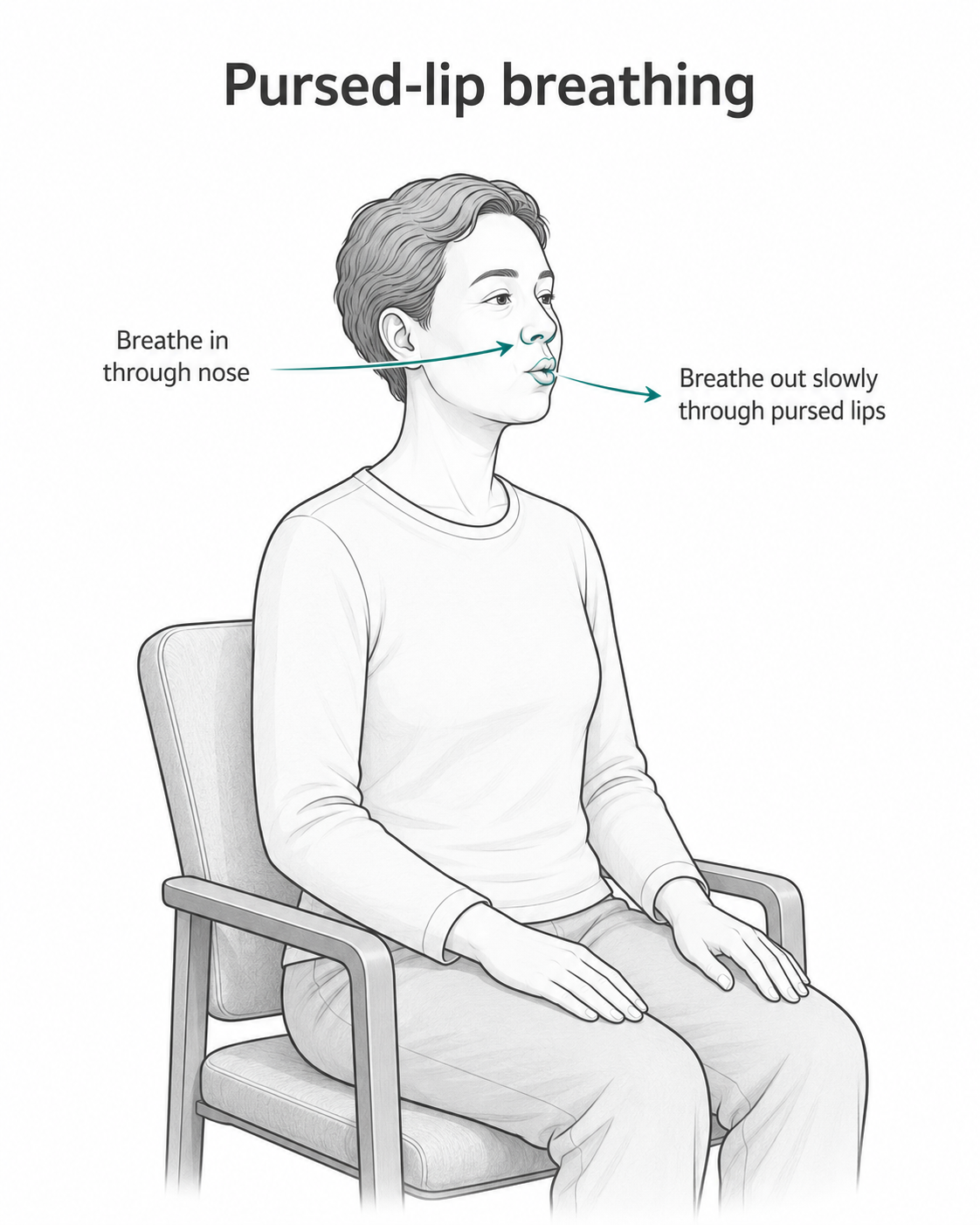
Diaphragmatic (relaxed, lower-chest) breathing
Many breathless people over-use the neck and shoulder muscles and breathe high in the chest. Diaphragmatic breathing shifts the effort back to the diaphragm — "nose, low and slow" — with the lower ribs and abdomen doing the work and the shoulders relaxed. It lowers the work of breathing and the sense of effort.2
Positions of ease and the handheld fan
Forward-lean positions — leaning on a table, on your knees, or against a wall — fix the shoulder girdle and let the breathing muscles work more efficiently, easing breathlessness quickly. A handheld fan directing a stream of cool air across the face genuinely reduces the sensation of breathlessness through stimulation of facial (trigeminal) nerves, and is a cheap, evidence-supported tool.
Breathing-pattern disorders
Sometimes breathlessness, sighing, dizziness, air hunger and chest tightness arise from a disordered breathing pattern rather than the lungs — often fast, shallow, upper-chest breathing that lowers carbon dioxide. Retraining restores nose breathing, a diaphragmatic pattern and a slower rate, bringing your carbon dioxide level back to normal.3 Structured methods such as the Papworth approach, and the Buteyko technique in asthma, formalise this.4 See our guide to dysfunctional breathing.
Evidence
Breathing exercises improve breathlessness and quality of life in COPD and asthma, and resolve symptoms in dysfunctional breathing.5 They complement — and never replace — prescribed inhaled treatment.
References & evidence base
- Holland AE, Hill CJ, Jones AY, McDonald CF. Breathing exercises for chronic obstructive pulmonary disease. Cochrane Database Syst Rev 2012;(10):CD008250.
- Bott J, Blumenthal S, Buxton M, et al. Guidelines for the physiotherapy management of the adult, medical, spontaneously breathing patient. Thorax 2009;64(Suppl 1):i1–i52.
- Jones M, Harvey A, Marston L, O'Connell NE. Breathing exercises for dysfunctional breathing/hyperventilation syndrome in adults. Cochrane Database Syst Rev 2013;(5):CD009041.
- Vagedes J, Helmert E, Kuderer S, et al. The Buteyko breathing technique in children and adults with asthma: a systematic review. Complement Ther Med 2021;60:102745.
- Santino TA, Chaves GS, Freitas DA, et al. Breathing exercises for adults with asthma. Cochrane Database Syst Rev 2020;(3):CD001277.
References are numbered in citation order (Vancouver/BMJ style) and were current at the time of writing. Guidelines are living documents — verify against the latest version before clinical use.
Everything starts with an assessment — your symptoms, breathing, exercise tolerance and daily function measured properly, so what follows is built on your lungs rather than an average.
Corrections: If something on this page is wrong, out of date or unclear, we want to know. Email reception@inspireclinic.au with the page name and what you believe is incorrect. Substantive corrections are made promptly, and the guide’s version and last-updated date are changed to reflect it.