Ahpra registration PHY0002298174
How these guides are written and reviewed →
A HandiHaler delivers one powder capsule at a time. You pierce the capsule with a side button, then breathe in slowly and deeply, fast enough to hear the capsule rattle. The capsules are for inhaling only and must never be swallowed.
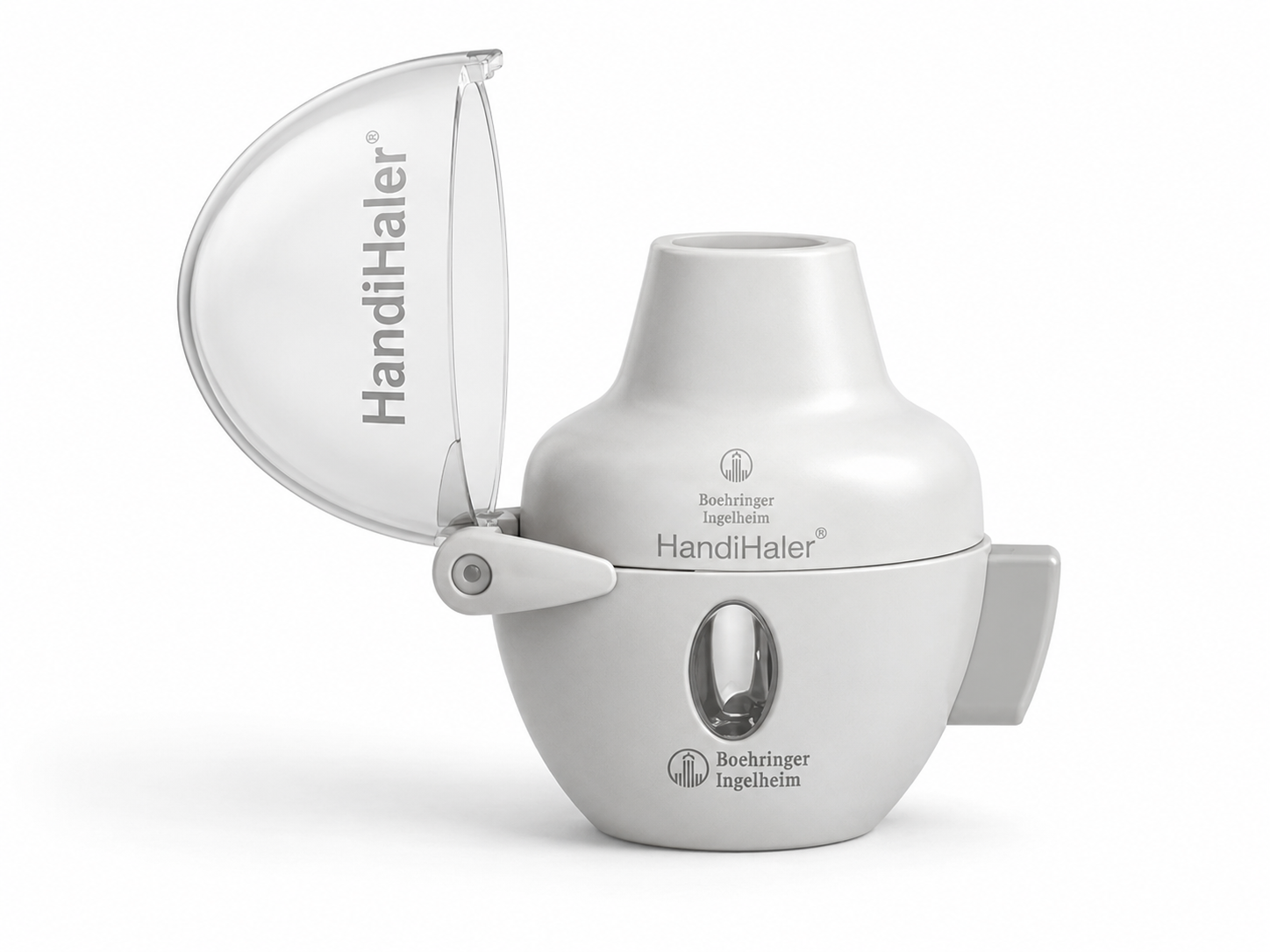
Spiriva HandiHaler (tiotropium) is taken once a day to keep the airways open over the whole day. It is not a rescue medicine and a second dose must not be taken during an attack. The capsules are for inhaling only — never swallow them. Keep your separate blue reliever with you.
Examples of this type
Different medicines come in this device. Common examples include:
- Spiriva HandiHaler (tiotropium)
Brand names are examples only and availability changes — always go by the name on your own inhaler and your prescriber's instructions.
How to use it — step by step
Getting the best from it
- Hearing/feeling the capsule vibrate confirms the dose is being drawn.1,2
- Press the piercing button once only — pressing repeatedly can shatter the capsule.
- Never swallow the capsules; load them only just before use.
Looking after your inhaler
Wipe the mouthpiece and chamber with a dry cloth; allow to air-dry fully if it gets damp. Keep capsules sealed until use.
Most people lose some accuracy over time.3,4 We can check your inhaler technique at your appointment.
References & evidence base
- National Asthma Council Australia. Inhaler technique for people with asthma or COPD. Information paper for health professionals. Melbourne: National Asthma Council Australia, 2026.
- Australian Commission on Safety and Quality in Health Care. Inhaler technique — device-specific checklists. Sydney: ACSQHC, 2020.
Further reading
- Sanchis J, Gich I, Pedersen S; ADMIT Group. Systematic review of errors in inhaler use: has patient technique improved over time? Chest 2016;150(2):394–406.
- Usmani OS, Lavorini F, Marshall J, et al. Critical inhaler errors in asthma and COPD: a systematic review of impact on health outcomes. Respir Res 2018;19(1):10.
References are numbered in citation order (Vancouver/BMJ style) and were current at the time of writing. Always follow the leaflet for your specific device and your prescriber's instructions.
Everything starts with an assessment — your symptoms, breathing, exercise tolerance and daily function measured properly, so what follows is built on your lungs rather than an average.
Corrections: If something on this page is wrong, out of date or unclear, we want to know. Email reception@inspireclinic.au with the page name and what you believe is incorrect. Substantive corrections are made promptly, and the guide’s version and last-updated date are changed to reflect it.