Ahpra registration PHY0002298174
How these guides are written and reviewed →
A Turbuhaler is a dry-powder inhaler. There is no spray — you draw the fine powder out yourself, so you need to breathe in forcefully and deeply. You load a dose by twisting the coloured grip at the base back and forth until it clicks.
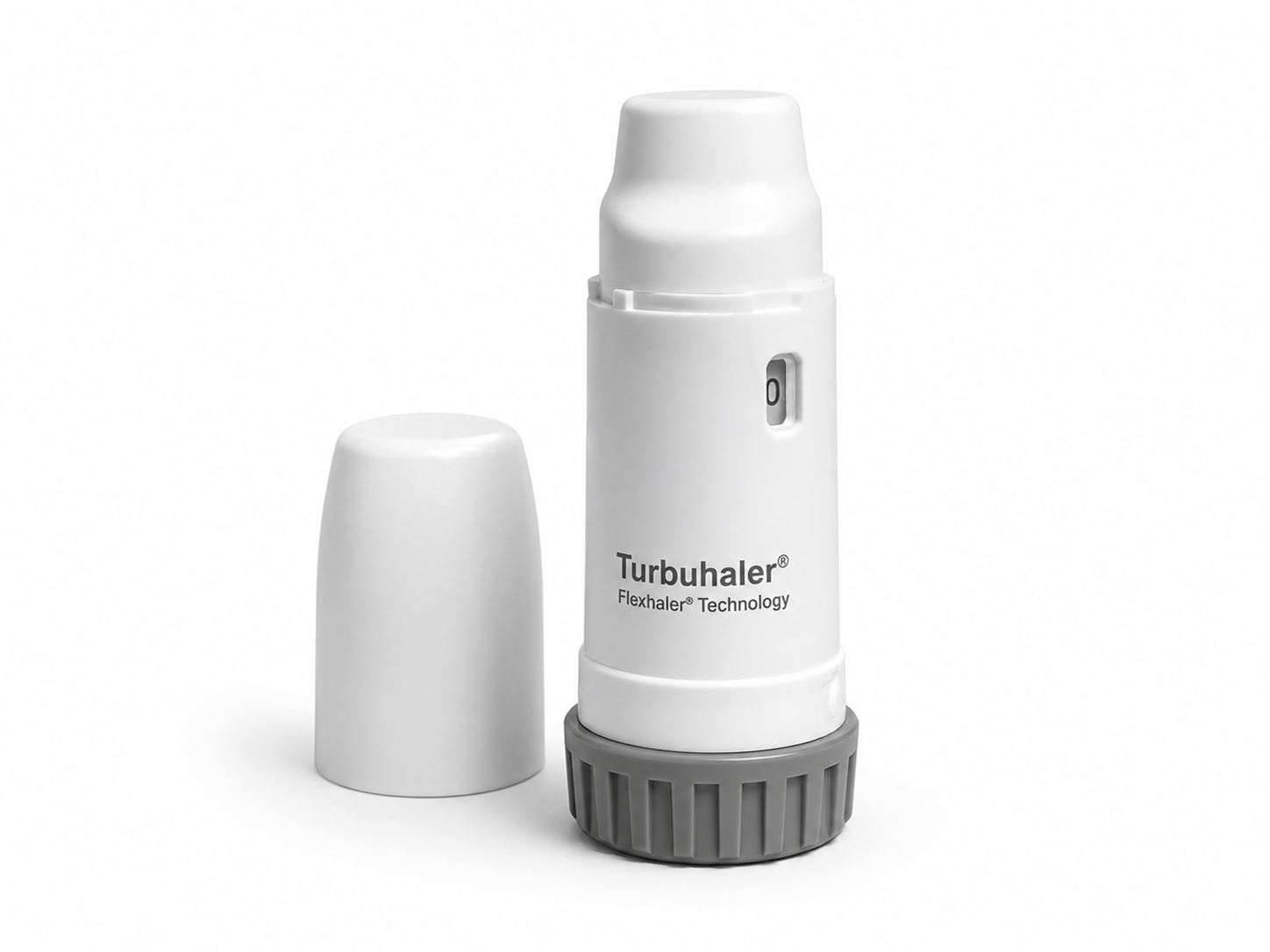
The Turbuhaler is a device, not a medicine. Bricanyl (terbutaline) is a fast-acting reliever; Pulmicort (budesonide) is a preventer; Symbicort (budesonide / formoterol) may be prescribed as a preventer only, or as both preventer and reliever (maintenance-and-reliever therapy, or MART). Extra doses are only safe if MART has been prescribed for you. Check the name on the inhaler, and follow your written action plan.
Examples of this type
Different medicines come in this device. Common examples include:
- Symbicort Turbuhaler (budesonide / formoterol)
- Pulmicort Turbuhaler (budesonide)
- Bricanyl Turbuhaler (terbutaline)
- Oxis Turbuhaler (formoterol)
Brand names are examples only and availability changes — always go by the name on your own inhaler and your prescriber's instructions.
How to use it — step by step
Getting the best from it
- A fast, hard inhalation is essential — you may not taste or feel the powder, and that is normal.1,2
- Keep it upright while loading, and keep it dry.
- Use the dose counter/window; a red mark means it is nearly empty.
Looking after your inhaler
Wipe the outside of the mouthpiece with a dry tissue weekly — never wash it or use water. Store with the cap on in a dry place.
Most people lose some accuracy over time.3,4 We can check your inhaler technique at your appointment.
References & evidence base
- National Asthma Council Australia. Inhaler technique for people with asthma or COPD. Information paper for health professionals. Melbourne: National Asthma Council Australia, 2026.
- Australian Commission on Safety and Quality in Health Care. Inhaler technique — device-specific checklists. Sydney: ACSQHC, 2020.
Further reading
- Sanchis J, Gich I, Pedersen S; ADMIT Group. Systematic review of errors in inhaler use: has patient technique improved over time? Chest 2016;150(2):394–406.
- Usmani OS, Lavorini F, Marshall J, et al. Critical inhaler errors in asthma and COPD: a systematic review of impact on health outcomes. Respir Res 2018;19(1):10.
References are numbered in citation order (Vancouver/BMJ style) and were current at the time of writing. Always follow the leaflet for your specific device and your prescriber's instructions.
Everything starts with an assessment — your symptoms, breathing, exercise tolerance and daily function measured properly, so what follows is built on your lungs rather than an average.
Corrections: If something on this page is wrong, out of date or unclear, we want to know. Email reception@inspireclinic.au with the page name and what you believe is incorrect. Substantive corrections are made promptly, and the guide’s version and last-updated date are changed to reflect it.