Ahpra registration PHY0002298174
How these guides are written and reviewed →
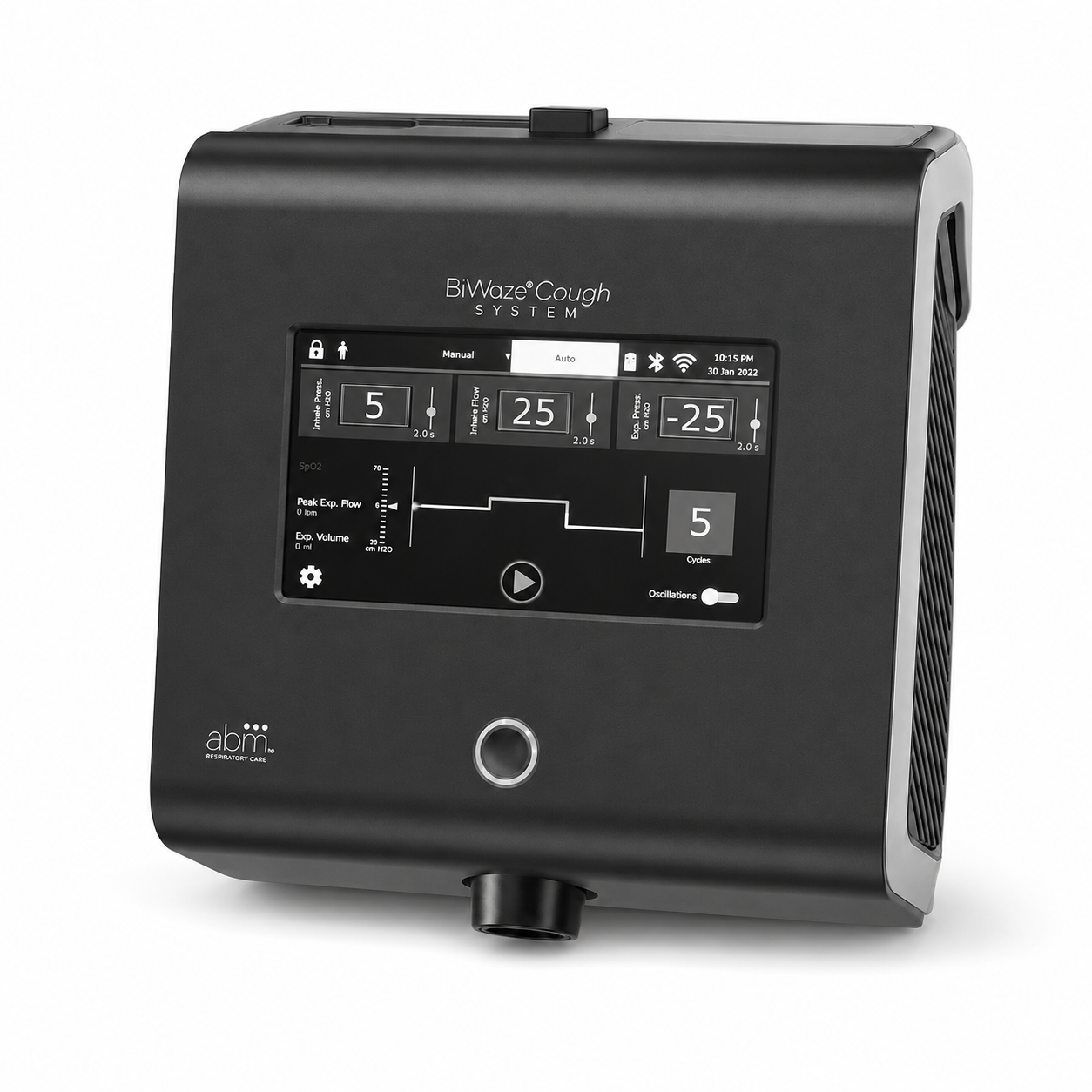
A cough-assist machine (mechanical insufflation–exsufflation, MI-E) helps people whose cough is too weak to clear mucus on their own. It gently delivers a deep breath in and then quickly switches to a pull outwards, mimicking a natural cough to bring secretions up. It is especially helpful for people with muscle-weakness conditions that affect breathing. The settings are individually adjusted and the technique taught by your physiotherapist. This page explains how cough assist works and who it helps.
An effective cough is the airway's emergency clearance system. When the muscles that power coughing are too weak — as in many neuromuscular conditions — a cough assist machine (mechanical insufflation–exsufflation, or MI-E) does the work for them.
How it works
The device delivers a deep positive-pressure breath in (insufflation), then rapidly switches to a strong negative pressure to pull air out (exsufflation). This sudden reversal recreates the high expiratory flow of a natural cough and drags secretions up towards the mouth, where they can be cleared or suctioned. An optional oscillation can be added to help shear mucus from the airway wall.1
Who it helps
MI-E is used where the cough is weak: motor neurone disease (MND/ALS), muscular dystrophy, spinal muscular atrophy, post-polio syndrome, high cervical spinal cord injury, and some patients with severe chronic obstructive pulmonary disease (COPD) and a feeble cough. The trigger to introduce it is a falling peak cough flow (how fast air leaves your lungs when you cough) — commonly considered when it drops below about 270 L/min, and clearly inadequate below 160 L/min, particularly during a chest infection.2
Settings
Pressures are titrated to the individual, often in the range of ±30 to ±50 cmH₂O, to achieve an effective cough. Lower pressures are used where there is bulbar weakness or a tendency to upper-airway collapse; higher pressures where airways are narrow or secretions thick. MI-E can be delivered via a face mask, mouthpiece or tracheostomy, and is usually given in sets of several cycles followed by a rest.3
Cautions
MI-E is avoided or used with caution in bullous emphysema, recent pneumothorax or barotrauma, recent facial or oral surgery, and haemodynamic instability. As with all airway clearance, it is introduced and titrated by a trained clinician.
Evidence and guidance
MI-E improves cough effectiveness and is recommended for airway clearance in neuromuscular disease4 — for example, in the NICE guideline on motor neurone disease (NG42)5 — and is frequently paired with airway clearance techniques and, where needed, non-invasive ventilation.
References & evidence base
- Chatwin M, Toussaint M, Gonçalves MR, et al. Airway clearance techniques in neuromuscular disorders: a state of the art review. Respir Med 2018;136:98–110.
- Toussaint M, Chatwin M, Gonzales J, Berlowitz DJ. 228th ENMC International Workshop: airway clearance techniques in neuromuscular disorders. Neuromuscul Disord 2018;28(3):289–298.
- Auger C, Hernando V, Galmiche H. Use of mechanical insufflation–exsufflation devices for airway clearance in subjects with neuromuscular disease. Respir Care 2017;62(2):236–245.
- Morrow B, Zampoli M, van Aswegen H, Argent A. Mechanical insufflation–exsufflation for people with neuromuscular disorders. Cochrane Database Syst Rev 2013;(12):CD010044.
- National Institute for Health and Care Excellence. Motor neurone disease: assessment and management (NG42). London: NICE, 2016.
References are numbered in citation order (Vancouver/BMJ style) and were current at the time of writing. Guidelines are living documents — verify against the latest version before clinical use.
Clearing mucus well is a skill rather than a machine. We match a technique to your lungs and your routine, then coach it until you can do it at home on a bad morning.
Corrections: If something on this page is wrong, out of date or unclear, we want to know. Email reception@inspireclinic.au with the page name and what you believe is incorrect. Substantive corrections are made promptly, and the guide’s version and last-updated date are changed to reflect it.