Ahpra registration PHY0002298174
How these guides are written and reviewed →
PEP (positive expiratory pressure) devices are small handheld tools you breathe out against to help clear mucus. The back-pressure holds the airways open and, in oscillating devices like the Acapella, Aerobika and Flutter, adds a vibration that loosens mucus from the airway walls. They are useful when breathing techniques alone are not enough, and are easy to use once shown. Your physiotherapist matches the device and settings to you. This page explains how these devices work and when we use them.
Positive expiratory pressure (PEP) devices and their oscillating cousins are simple handheld tools that make airway clearance more effective when mucus is tenacious or airways tend to collapse. They are adjuncts to — not replacements for — active breathing techniques such as ACBT.
How PEP works
Breathing out against a fixed resistance generates a back-pressure of roughly 10–20 cmH₂O. This splints the airways open during expiration, lets air get behind secretions through collateral channels, and prevents the early airway collapse that traps mucus in conditions such as chronic obstructive pulmonary disease (COPD) and bronchiectasis. The result is air behind the mucus and a more open path for it to travel out.1
Oscillating PEP
Oscillating devices add a vibration to the back-pressure. The airflow oscillation (around 10–25 Hz) shears mucus off the airway wall and lowers its viscosity, while the PEP holds the airways open — a combination that is often more comfortable and more productive than PEP alone.2
| Device | How it works | Best fit | Practical points |
|---|---|---|---|
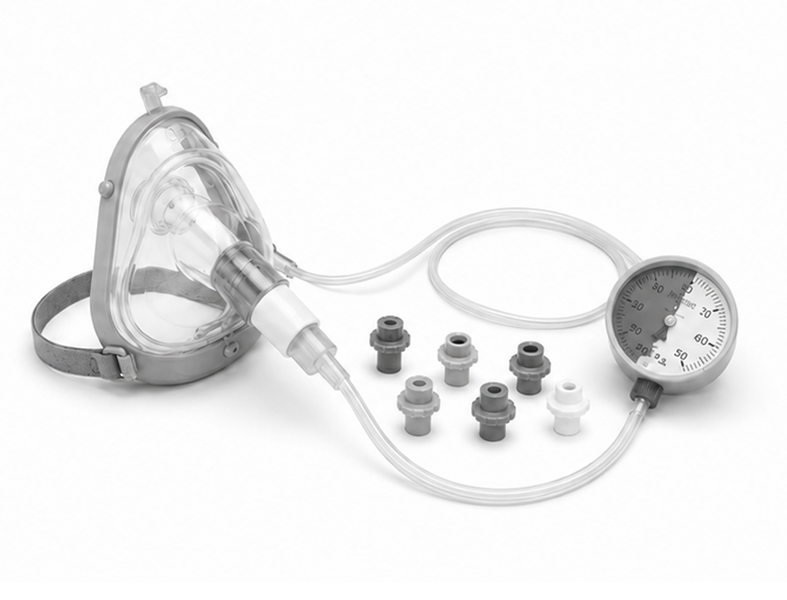
| PEP (mask or mouthpiece) | Fixed-orifice resistor gives 10–20 cmH₂O steady back-pressure | Bronchiectasis, COPD exacerbation, post-operative atelectasis | Set resistance to a steady mid-expiratory pressure; cycles of 10–15 breaths |
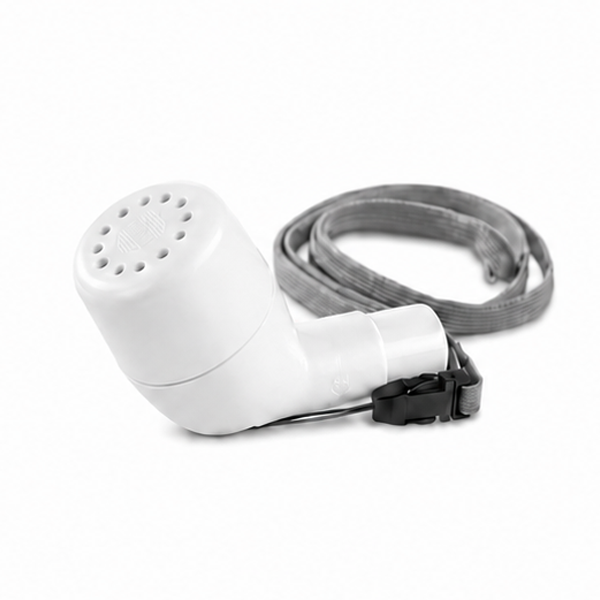
| Flutter | PEP plus about 15 vibrations a second (15 Hz) from a steel ball in a cone | Bronchiectasis, cystic fibrosis (CF), COPD with mucus hypersecretion | Must be held upright; tilt angle tunes the oscillation |
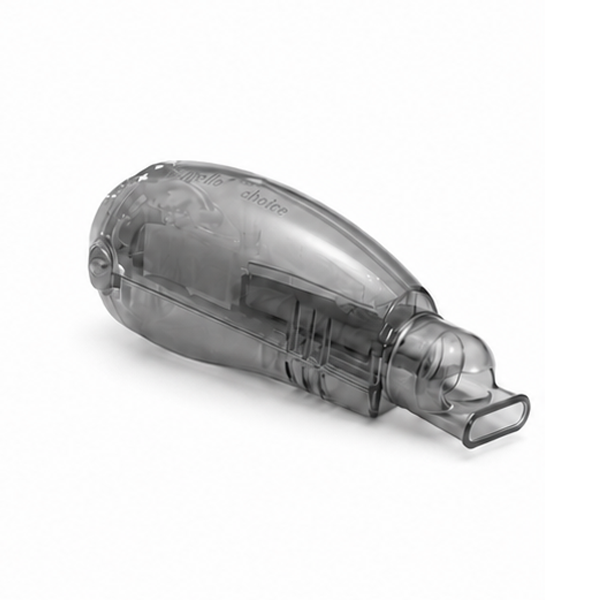
| Acapella | PEP plus oscillation via a counterweighted plug and magnet — works in any orientation | As above, plus bed-bound patients | Green = higher flow (>15 L/min); blue = lower flow (<15 L/min) |
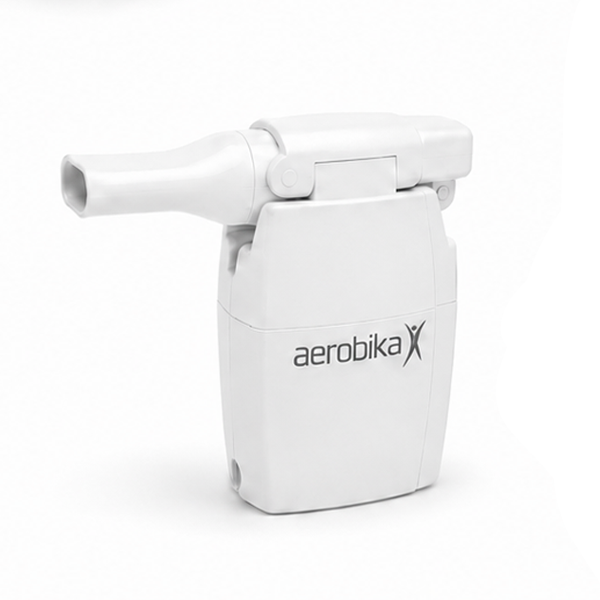
| Aerobika | PEP plus oscillation with adjustable frequency/amplitude | Bronchiectasis (PBAC-listed in Australia), CF, COPD | Tunable dial supports individualised prescription |
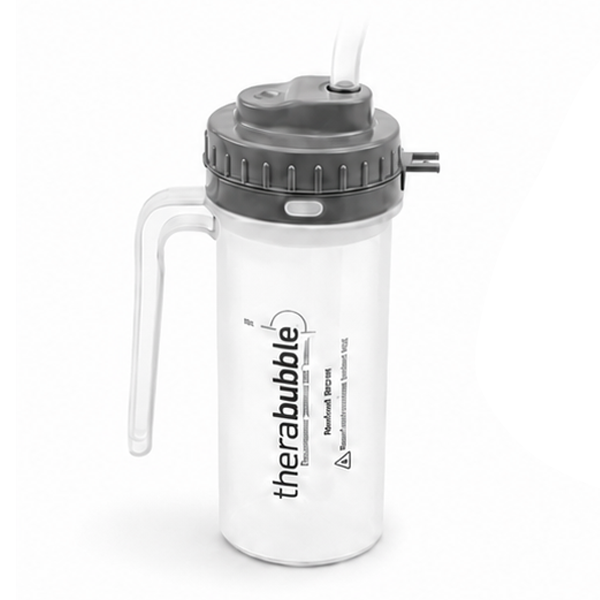
| Bubble PEP | Improvised PEP by blowing through tubing into ~10 cm of water | Paediatrics, low-resource or interim use, post-op atelectasis | Simple and cheap; less precise pressure; mind hygiene |
For patients who genuinely cannot self-clear, high-frequency chest wall oscillation (the "Vest") is an option, but for most ambulatory adults a well-taught technique with a handheld PEP device outperforms bulkier equipment in real-world outcomes.
The main devices
The oscillating devices differ mainly in how they generate the vibration and whether they work in any position. Your physiotherapist matches the device to your airflow, dexterity and preference.
How a session runs
A typical session is several cycles of 10–15 breaths out through the device, each cycle finished with one or two huffs (the forced expiration technique) to clear the mobilised mucus, repeated for 10–20 minutes once or twice daily. Pairing the device with nebulised hypertonic saline beforehand increases its effect.
Cautions
PEP is avoided in untreated pneumothorax, after recent facial, oral or skull surgery, and with significant haemoptysis; it also needs a reasonable inspiratory volume to be effective. Devices should be cleaned and dried after every use.
Evidence and selection
PEP and oscillating PEP are recommended airway-clearance options in cystic fibrosis and bronchiectasis, with no single device shown to be clearly superior.3,4 Choice is therefore guided by the airflow the patient can generate, comfort, portability and preference — and reviewed at each visit.
ACBT versus devices — what the evidence shows
Head-to-head trials and Cochrane reviews in both bronchiectasis and cystic fibrosis consistently find no single airway-clearance technique is reliably superior to another when each is taught well and done properly — ACBT, PEP and oscillating PEP produce broadly equivalent sputum clearance, lung function and quality of life over a treatment period.5 Differences between techniques in trials are small and inconsistent, whereas the difference made by how consistently a patient sticks with their technique is large and consistent — so adherence, not the choice of device, is the strongest predictor of results. Two practical nuances do emerge: adding postural drainage to ACBT can roughly double sputum cleared in a single session for those who tolerate positioning, and oscillating devices can have an edge when secretions are especially thick or tenacious. In short, the best technique is the one you will actually do every day, and many patients keep ACBT as an equipment-free fallback alongside a device.
The Vest — high-frequency chest wall oscillation (HFCWO)
The Vest is a system of high-frequency chest wall oscillation (HFCWO): an inflatable jacket, connected to an air-pulse generator, rapidly compresses and releases the chest wall many times per second (typically 5–20 Hz). These rapid oscillations are thought to loosen secretions and shear them from the airway walls, moving them towards the larger airways where they can be cleared with huffing or coughing. Because it is hands-free and works in any position, it can suit people who find self-directed techniques tiring or difficult — for example those with neuromuscular weakness, reduced dexterity, or difficulty sustaining a manual regimen. Sessions usually last 20–30 minutes, once or twice daily, and are combined with periodic huffing and, where prescribed, nebulised hypertonic saline. The evidence base is modest: systematic-review data in cystic fibrosis show HFCWO is broadly as effective as other airway-clearance techniques for lung function and secretion clearance, but it has not been shown to be superior, and it is substantially more expensive and less portable.6 Guidelines therefore position it as one option among several rather than a first-line choice, reserved mainly for patients in whom simpler, lower-cost techniques are unsuitable or have not worked. HFCWO is used considerably more widely in the United States than in the UK or Australia, where hand-held oscillating devices and active techniques such as ACBT are generally preferred as first-line. As with every technique, the most effective device is the one the patient will use consistently.
References & evidence base
- Demchuk AM, Chatburn RL. Performance characteristics of positive expiratory pressure devices. Respir Care 2021;66(3):482–493.
- Morrison L, Innes S. Oscillating devices for airway clearance in people with cystic fibrosis. Cochrane Database Syst Rev 2017;(5):CD006842.
- Hill AT, Sullivan AL, Chalmers JD, et al. British Thoracic Society guideline for bronchiectasis in adults. Thorax 2019;74(Suppl 1):1–69.
- McIlwaine M, Button B, Nevitt SJ. Positive expiratory pressure physiotherapy for airway clearance in people with cystic fibrosis. Cochrane Database Syst Rev 2019;(11):CD003147.
- Lee AL, Burge AT, Holland AE. Positive expiratory pressure therapy versus other airway clearance techniques for bronchiectasis. Cochrane Database Syst Rev 2017;(9):CD011699.
- Volsko TA. Airway clearance therapy: finding the evidence. Respir Care 2013;58(10):1669–1678.
References are numbered in citation order (Vancouver/BMJ style) and were current at the time of writing. Guidelines are living documents — verify against the latest version before clinical use.
Clearing mucus well is a skill rather than a machine. We match a technique to your lungs and your routine, then coach it until you can do it at home on a bad morning.
Corrections: If something on this page is wrong, out of date or unclear, we want to know. Email reception@inspireclinic.au with the page name and what you believe is incorrect. Substantive corrections are made promptly, and the guide’s version and last-updated date are changed to reflect it.