Ahpra registration PHY0002298174
How these guides are written and reviewed →
The Active Cycle of Breathing Techniques (ACBT) are a simple, equipment-free way to clear mucus from the lungs using your own breathing. Each cycle has four steps:
- Breathing control: relaxed, gentle breathing.
- 2–4 deep breaths, to get air behind the mucus.
- 1–2 huffs, to move it up and out.
- Back to breathing control.
It is effective, gentle and can be done almost anywhere once learned. This page covers both ways it is used: weighted for clearing excess secretions, and weighted for re-expanding under-inflated lung.
ACBT for clearing secretions
The Active Cycle of Breathing Techniques are the cornerstone airway clearance approach at Inspire Clinic — and our primary technique. It is patient-controlled, needs no equipment, is supported by evidence across many conditions, and adapts to almost any presentation.1 It can be taught in a single session and performed independently at home for life.
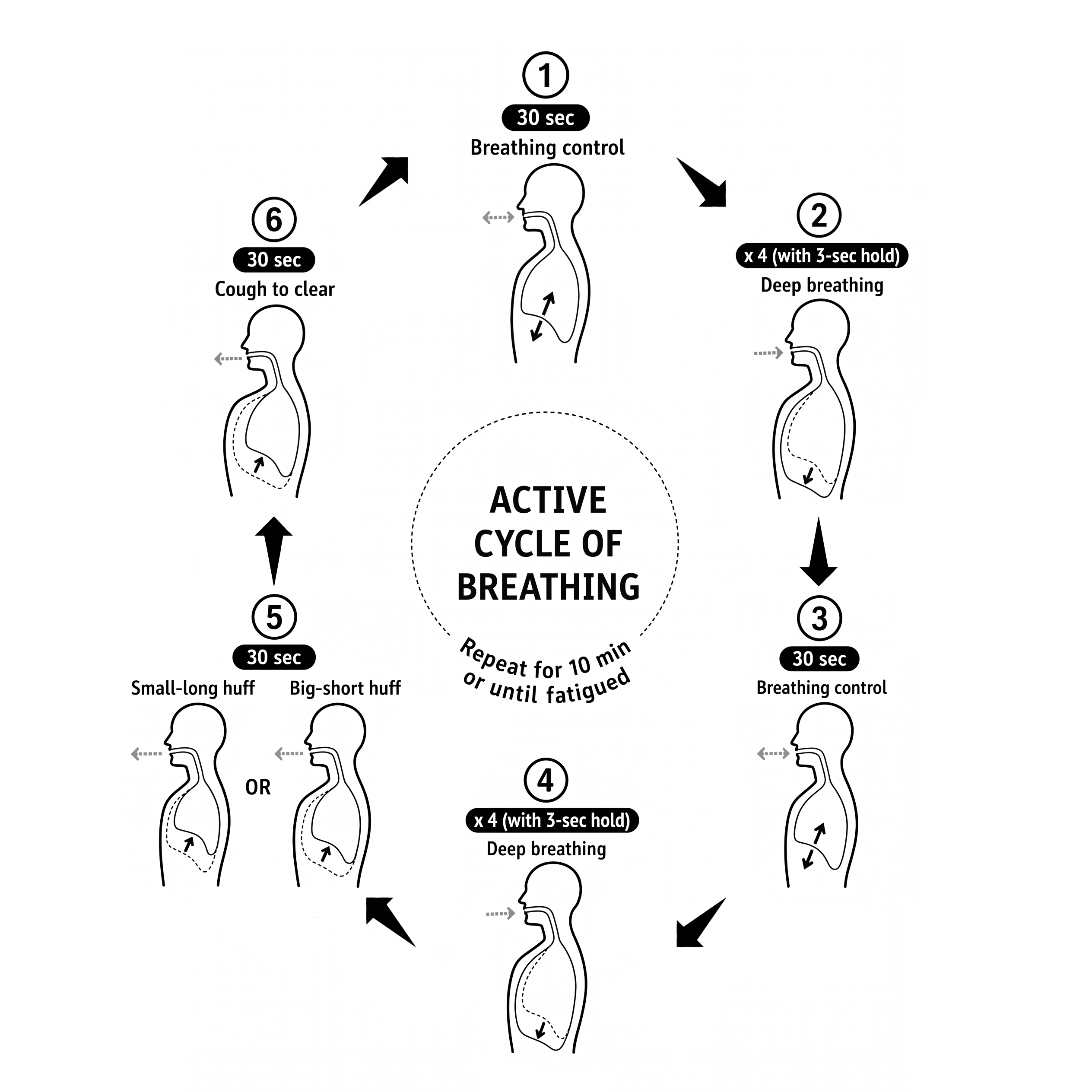
The three components
Breathing control — gentle, tidal-volume breathing at your own rate, relaxing the upper chest and shoulders with soft abdominal movement. Used between the more active components to prevent fatigue and avoid triggering bronchospasm.
Thoracic expansion exercises — three to four slow, deep breaths in to near-full lung capacity with a relaxed breath out. An optional 3-second hold at the top recruits collateral ventilation (through the pores of Kohn and channels of Lambert) to get air behind secretions; manual percussion or vibration over the chest can be added during the breath out if appropriate.
Forced expiration technique (the "huff") — one or two huffs at different lung volumes, followed by breathing control. A huff from mid-to-low lung volume mobilises peripheral secretions; a huff from high lung volume clears the more central airways. A huff (breathing out forcefully through an open mouth and throat, as if misting a mirror) clears mucus with far less airway collapse and fatigue than repeated hard coughing.2
A typical clearance cycle
Two to four rounds of thoracic expansion, then one to two huffs, then a return to breathing control before the next round. Sessions usually last 15–25 minutes, once or twice daily — longer during an exacerbation. ACBT can be performed sitting, in side-lying, or in modified postural drainage positions.
Adapted for retained secretions
When the problem is excess secretion with intact lung volume, the cycle is weighted towards the forced expiration component: longer huffs across a range of lung volumes, starting low to engage the peripheral airways. Pair it with nebulised hypertonic saline beforehand, and with an oscillating PEP device if mucus is particularly tenacious. Two cycles a day is typical, more during an exacerbation.3
Why we favour it
Systematic review evidence shows ACBT is at least as effective as other airway clearance techniques,4,5 with the practical advantages of being free, portable and sustainable — which translates into the day-to-day adherence that ultimately drives results.
ACBT for lung expansion
Used this way, ACBT is a gentle, equipment-free way to re-inflate under-used or collapsed parts of the lung. It is patient-controlled, can be taught in a single session, and is done sitting or lying. For lung expansion it uses a continuous cycle of just two components — breathing control and thoracic expansion exercises with breath-holds. The forced huff and the cough of the secretion-clearance version are deliberately not used: the aim is to draw air in and hold it behind collapsed lung, not to force air out.1
When it is used
- Before surgery (prehabilitation) — learning and practising the technique so it can be used well afterwards.
- After surgery — especially abdominal and thoracic surgery, where pain and shallow breathing lead to collapse at the lung bases.
- Conditions known to cause airway or alveolar collapse (atelectasis) — and any situation where parts of the lung are under-inflated.
The two components
Breathing control — gentle, relaxed tidal breathing at your own rate, letting the lower chest and abdomen do the work while the upper chest and shoulders stay relaxed. It is used between the active deep breaths to prevent fatigue and breathlessness.
Thoracic expansion exercises — slow, deep breaths in to near-full lung capacity, each followed by a 3-second breath-hold at the top before a relaxed, passive breath out. The hold is the key ingredient: it recruits collateral ventilation (through the pores of Kohn and channels of Lambert), letting air move behind and beneath collapsed lung to re-open it. A gentle sniff at the top of the breath, or manual support over the surgical site, can help.
A typical lung-expansion cycle
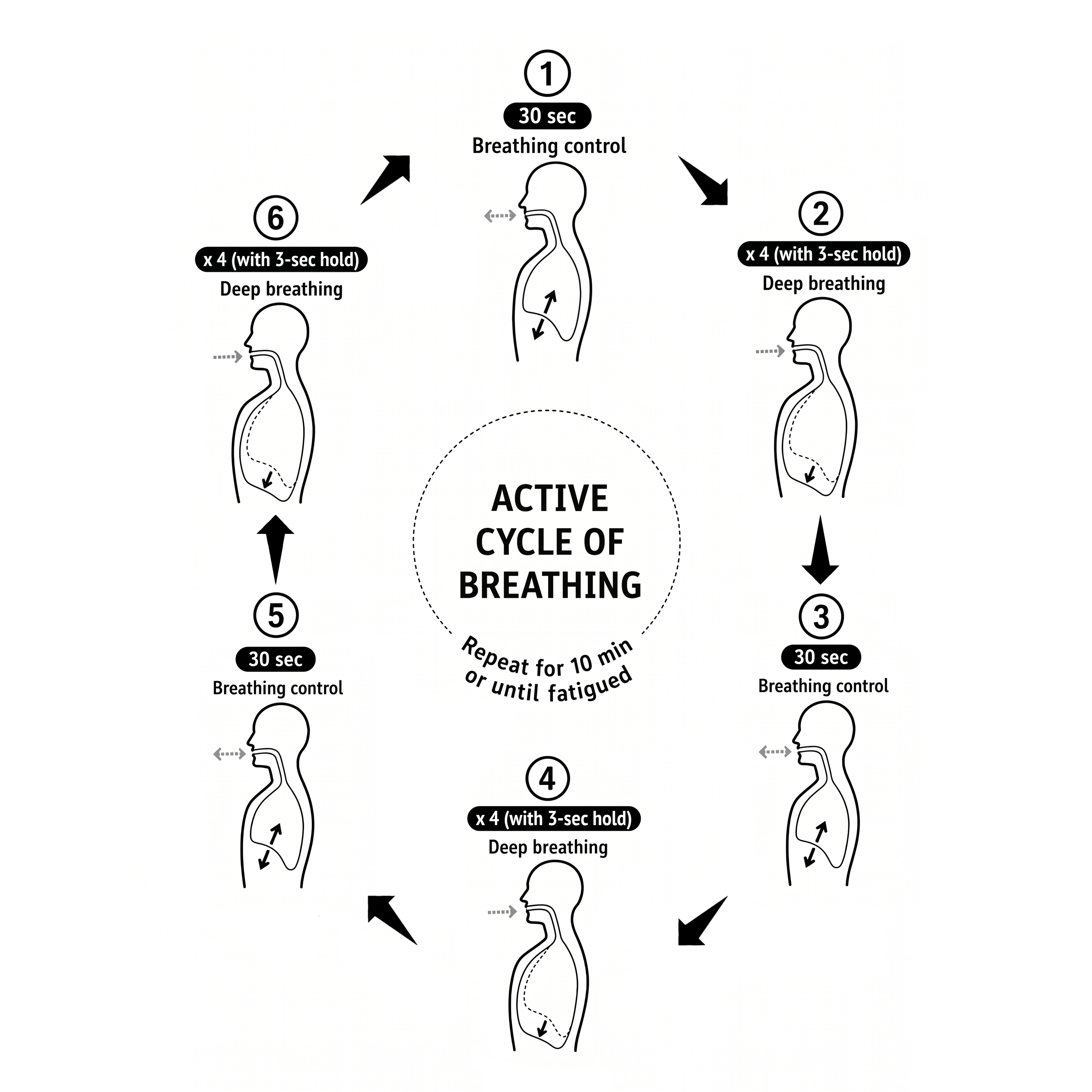
The technique alternates continuously between the two components — for example three to four thoracic-expansion breaths with holds, then a short spell of breathing control to recover, then the next set of deep breaths. There is no huff and no forced cough. Sessions are short (about 5–10 minutes) but repeated often — commonly every 1–2 hours in the early post-operative period — and are most effective sitting upright or with the affected lung uppermost. If a cough happens naturally it is fine to clear it, but coughing is not a planned part of this cycle.2
References & evidence base
- McIlwaine M, Bradley J, Elborn JS, Moran F. Personalising airway clearance in chronic lung disease. Eur Respir Rev 2017;26(143):160086.
- Fink JB. Forced expiratory technique, directed cough, and autogenic drainage. Respir Care 2007;52(9):1210–1223.
- Hill AT, Sullivan AL, Chalmers JD, et al. British Thoracic Society guideline for bronchiectasis in adults. Thorax 2019;74(Suppl 1):1–69.
- Lewis LK, Williams MT, Olds TS. The active cycle of breathing technique: a systematic review and meta-analysis. Respir Med 2012;106(2):155–172.
- McKoy NA, Wilson LM, Saldanha IJ, et al. Active cycle of breathing technique for cystic fibrosis. Cochrane Database Syst Rev 2016;(7):CD007862.
References are numbered in citation order (Vancouver/BMJ style) and were current at the time of writing. Guidelines are living documents — verify against the latest version before clinical use.
Clearing mucus well is a skill rather than a machine. We match a technique to your lungs and your routine, then coach it until you can do it at home on a bad morning.
Corrections: If something on this page is wrong, out of date or unclear, we want to know. Email reception@inspireclinic.au with the page name and what you believe is incorrect. Substantive corrections are made promptly, and the guide’s version and last-updated date are changed to reflect it.