Ahpra registration PHY0002298174
How these guides are written and reviewed →
Your airways are lined with a thin layer of mucus that traps dust, germs and other particles you breathe in. Tiny hair-like cells called cilia constantly sweep this mucus up towards your throat, where it is swallowed or coughed out — a built-in self-cleaning system. In conditions such as cystic fibrosis and bronchiectasis the airway surface dries out, the mucus turns thick and sticky, and this cleaning system stalls. Airway clearance therapy — breathing techniques, devices and good hydration — helps loosen that mucus and move it out. Nebulised salty water (hypertonic saline) pulls moisture back onto the airway surface, thinning the mucus so the cilia can work again.
Airway Clearance
Airway clearance therapy aims to mobilise and remove excess bronchial secretions, reduce airway resistance, improve gas exchange, and lower the risk of infection and exacerbation. This guide explains how the airway keeps itself clean, why that system fails in disease, and how we restore it — including the role of nebulised hypertonic saline. The hands-on techniques themselves have their own guides: the Active Cycle of Breathing Techniques (ACBT), positive expiratory pressure (PEP) devices and autogenic drainage.
Principles of airway clearance
All airway clearance techniques work through the same three steps: loosening secretions (through hydration, humidification, deep breathing and oscillation), mobilising them from the small peripheral airways towards the larger central ones, and removing them with a huff or a directed cough. Technique selection is individualised to the disease, secretion load, ability, preference and equipment access. There is no single superior technique — adherence is the most important predictor of effectiveness.1
The mucociliary tract
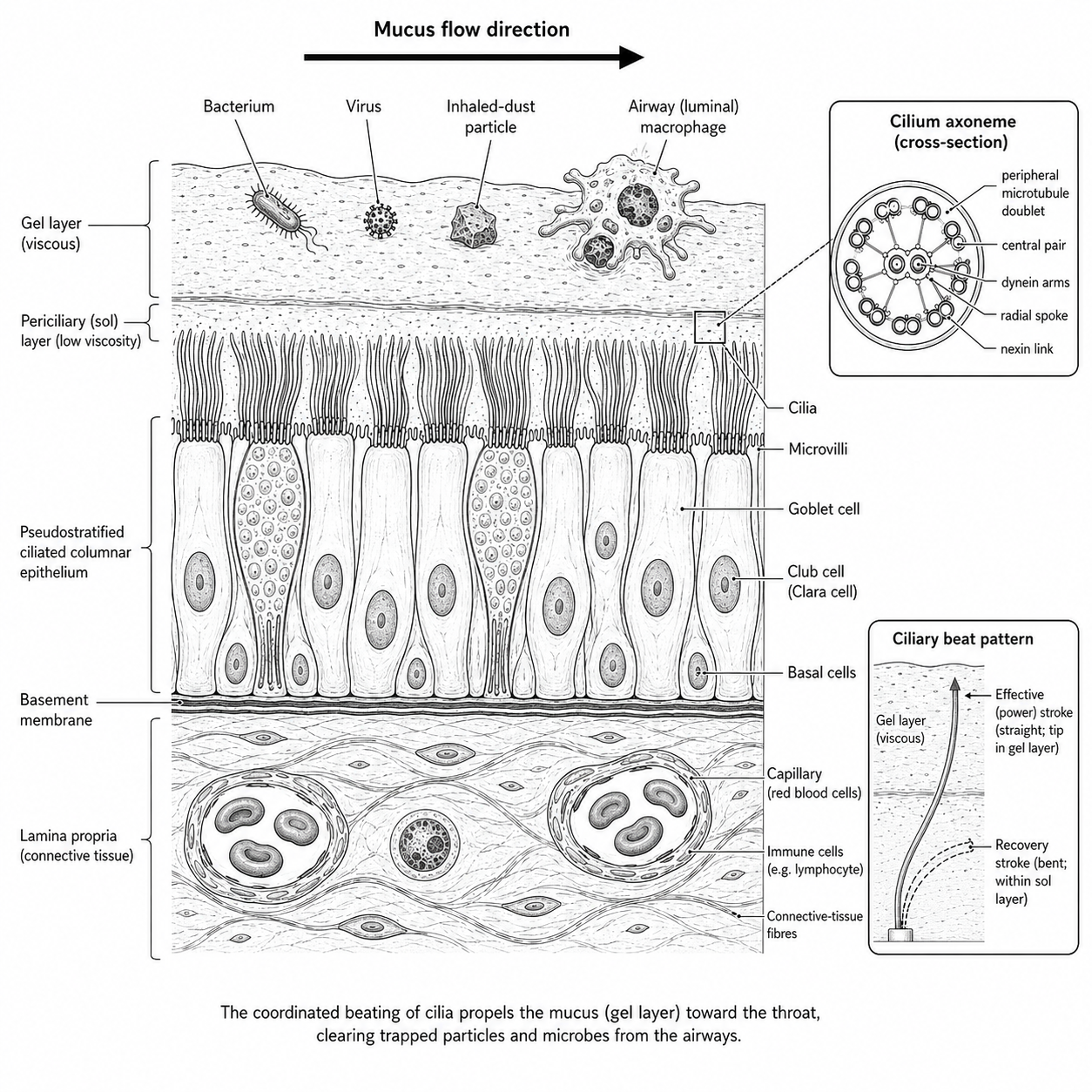
The mucociliary escalator is the principal defence mechanism of the conducting airways. It moves inhaled particles, microorganisms and cellular debris from the distal airways up the tracheobronchial tree to the larynx, where they are swallowed or coughed up (expectorated). In a healthy adult, it clears the entire conducting airway roughly every 24 hours.
The airway lining is a two-layered fluid system. Closest to the epithelium is the periciliary liquid layer (PCL, or "sol" layer) — a thin, watery layer about 7 micrometres deep that exactly matches the height of an extended cilium. The cilia, beating about 12–15 times per second (12–15 Hz) in a coordinated, wave-like (metachronal) rhythm, sit within this watery layer. Above it lies the mucus ("gel") layer — thicker and composed of secreted mucins (MUC5AC and MUC5B), water, electrolytes, antimicrobial peptides, immunoglobulins and trapped particulate matter.2
The two layers function as a conveyor belt: the cilia beat freely within the PCL, their tips just engaging the overlying mucus at the top of each forward stroke, advancing the mucus blanket upward towards the throat (cephalad) at roughly 4–20 mm per minute in the trachea, slowing progressively in the smaller peripheral airways. The system depends on three conditions — intact, coordinated ciliary beating; an adequate periciliary liquid volume; and mucus of the correct consistency (viscous enough to move as a sheet, but not so viscous that the cilia cannot engage it).
Airway surface liquid: hydration and dehydration
Airway surface liquid (ASL) volume is regulated by ion and water transport across the epithelium. Sodium absorption via the epithelial sodium channel (ENaC) draws water out of the airway, while chloride and bicarbonate secretion via the cystic fibrosis transmembrane conductance regulator (CFTR) and other channels draws water in. The balance maintains the periciliary layer at the depth needed for ciliary function.
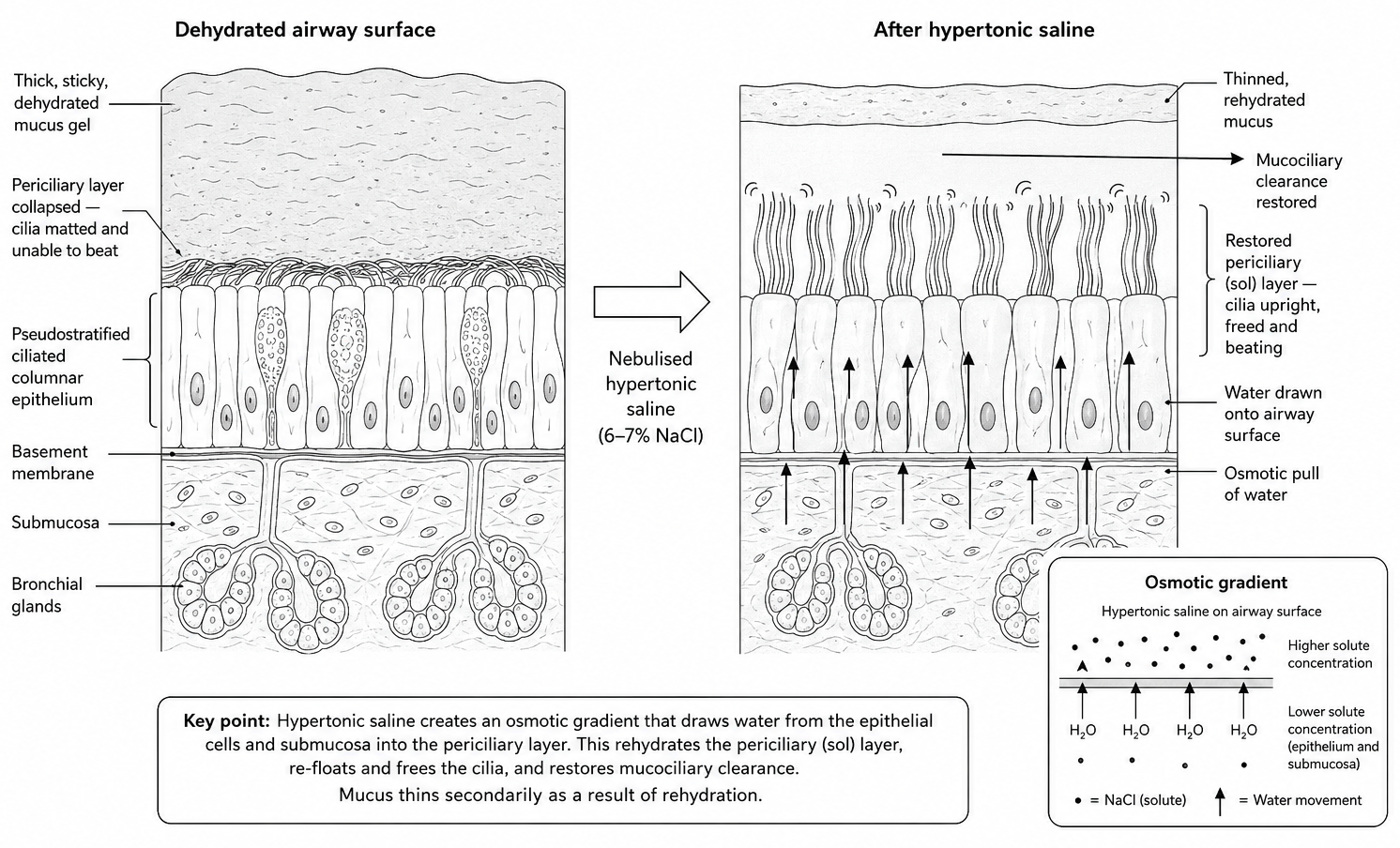
When this regulation fails, the airway becomes dehydrated. In cystic fibrosis (CF), defective CFTR reduces chloride and bicarbonate secretion while sodium absorption continues, collapsing the periciliary layer. Similar end-results — through different molecular routes — drive the impaired clearance of non-CF bronchiectasis, primary ciliary dyskinesia and chronic bronchitis.
Dehydrated mucus is more viscous, more elastic, more adherent to the epithelium, and harder to clear with a cough. It also forms thicker, more organised biofilms that shield bacteria from host defences and antibiotics. Rehydrating the airway is therefore one of the most direct ways to improve clearance.3
How hypertonic saline works
Hypertonic saline (3% or 6% sodium chloride, e.g. PARI MucoClear®, versus the 0.9% of isotonic saline) is a hyperosmolar agent. Inhaled as an aerosol and deposited on the airway surface, it creates an osmotic gradient that draws water from the bronchial epithelium into the periciliary layer and the overlying mucus.4
This produces four interconnected effects: it rehydrates the periciliary layer, restoring the depth cilia need to beat and engage the mucus; it hydrates the mucus itself, lowering its viscosity and elasticity; it reduces mucus adherence to the epithelium; and it acts as a powerful cough stimulant, the osmotic shift triggering airway sensory nerves to produce a productive cough. A single 4 mL dose can restore hydration, lower viscosity, release adherent mucus and trigger productive coughing — all of which compound the airway clearance session that follows it.
Hypertonic saline and airway hygiene
Beyond these mechanical effects, hypertonic saline supports airway hygiene. By improving mucociliary clearance it reduces the dwell time of inhaled bacteria, viruses and particulates; by breaking down mucus plugs and biofilm it exposes trapped bacteria to host defences and antibiotics; and by reducing the chronic mucus stasis that drives neutrophilic inflammation, it interrupts the bronchiectatic "vicious cycle" at several points at once. This is why a simple, inexpensive intervention produces measurable reductions in exacerbations in cystic fibrosis (and, with a smaller effect, in non-CF bronchiectasis), along with improvements in lung function, sputum clearance and quality of life.5
Dornase alfa (DNase)
In cystic fibrosis, the DNA released by degraded white cells makes sputum especially thick and sticky. Inhaled dornase alfa cleaves this DNA, reducing viscosity. It is established therapy in CF but is not routinely effective in non-CF bronchiectasis, where hypertonic saline and physical techniques are preferred.
Gravity-assisted (postural) positioning
Positioning the body so gravity assists drainage of a targeted lung region remains a useful adjunct, particularly for focal disease. Modified postural drainage — without head-down tilt — is used where reflux, breathlessness, cardiac instability or raised intracranial pressure make the classic tipped positions unsafe.
Putting it together
The practical sequence at Inspire Clinic is: pre-treatment with a short-acting bronchodilator (to manage bronchospasm risk and open the airways) → nebulised hypertonic saline (typically 4 mL of 3% or 6% PARI MucoClear® via a mesh or jet nebuliser) → immediate airway clearance using the patient's preferred technique, so the mobilisation and cough effort happen while hydration and viscosity reduction are at their peak.
References & evidence base
- Hill AT, Sullivan AL, Chalmers JD, et al. British Thoracic Society guideline for bronchiectasis in adults. Thorax 2019;74(Suppl 1):1–69.
- Button B, Cai L-H, Ehre C, et al. A periciliary brush promotes the lung health by separating the mucus layer from airway epithelia. Science 2012;337(6097):937–941.
- Boucher RC. Muco-obstructive lung diseases. N Engl J Med 2019;380(20):1941–1953.
- Elkins MR, Bye PTP. Mechanisms and applications of hypertonic saline. J R Soc Med 2011;104(Suppl 1):S2–S5.
- Wark P, McDonald VM. Nebulised hypertonic saline for cystic fibrosis. Cochrane Database Syst Rev 2018;(9):CD001506.
References are numbered in citation order (Vancouver/BMJ style) and were current at the time of writing. Guidelines are living documents — verify against the latest version before clinical use.
More than one of our services applies here, and which combination suits you depends on what your assessment shows.
Corrections: If something on this page is wrong, out of date or unclear, we want to know. Email reception@inspireclinic.au with the page name and what you believe is incorrect. Substantive corrections are made promptly, and the guide’s version and last-updated date are changed to reflect it.