Ahpra registration PHY0002298174
How these guides are written and reviewed →
An Autohaler is a "puffer" that fires itself. Instead of pressing a canister at just the right moment, you raise a lever to prime it, then simply breathe in — and the inhaler releases the dose automatically as you do. This makes it a good choice for people who find the timing of an ordinary pMDI difficult. You still need a steady, deep breath in, and you must keep breathing in after it fires.
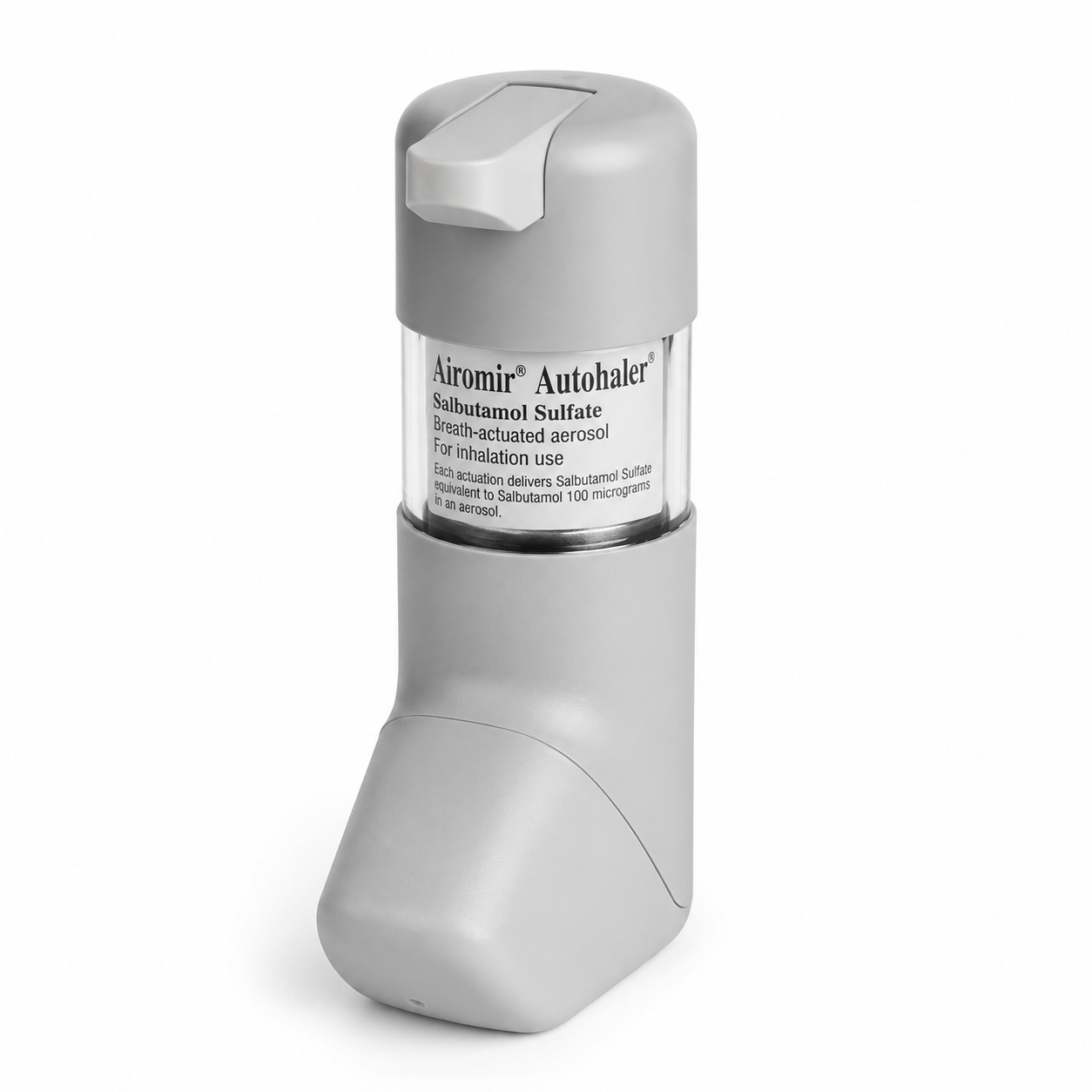
The Autohaler is a device, not a medicine — an Airomir Autohaler (salbutamol) is a fast-acting reliever, while a QVAR Autohaler (beclometasone) is a preventer that works gradually and will not help during an attack. They look similar. Check the name on the inhaler before you take it, and keep your reliever separate and easy to find.
Examples of this type
Different medicines come in this device. Common examples include:
- Airomir Autohaler (salbutamol)
- QVAR Autohaler (beclometasone)
Brand names are examples only and availability changes — always go by the name on your own inhaler and your prescriber's instructions.
How to use it — step by step
Getting the best from it
- Keep breathing in after it clicks — stopping when it fires is the most common mistake.1,2
- Raise the lever before each dose and lower it after; only one dose fires per priming.
- Do not cover the air vents at the base with your hand or lips.
Looking after your inhaler
Wipe the plastic mouthpiece weekly with a dry tissue — do not wash the metal canister or immerse the device. Keep the cover on, and store it upright in a dry place. Track the doses so you replace it before it runs out.
Most people lose some accuracy over time.3,4 We can check your inhaler technique at your appointment.
References & evidence base
- National Asthma Council Australia. Inhaler technique for people with asthma or COPD. Information paper for health professionals. Melbourne: National Asthma Council Australia, 2026.
- Australian Commission on Safety and Quality in Health Care. Inhaler technique — device-specific checklists. Sydney: ACSQHC, 2020.
Further reading
- Sanchis J, Gich I, Pedersen S; ADMIT Group. Systematic review of errors in inhaler use: has patient technique improved over time? Chest 2016;150(2):394–406.
- Usmani OS, Lavorini F, Marshall J, et al. Critical inhaler errors in asthma and COPD: a systematic review of impact on health outcomes. Respir Res 2018;19(1):10.
References are numbered in citation order (Vancouver/BMJ style) and were current at the time of writing. Always follow the leaflet for your specific device and your prescriber's instructions.
Everything starts with an assessment — your symptoms, breathing, exercise tolerance and daily function measured properly, so what follows is built on your lungs rather than an average.
Corrections: If something on this page is wrong, out of date or unclear, we want to know. Email reception@inspireclinic.au with the page name and what you believe is incorrect. Substantive corrections are made promptly, and the guide’s version and last-updated date are changed to reflect it.