Ahpra registration PHY0002298174
How these guides are written and reviewed →
A Breezhaler uses individual capsules of powder that you load one at a time. You pierce the capsule with side buttons, then breathe in quickly and deeply — you should hear the capsule spin and rattle, which tells you it is working. Capsules are for inhaling only, never swallowing.
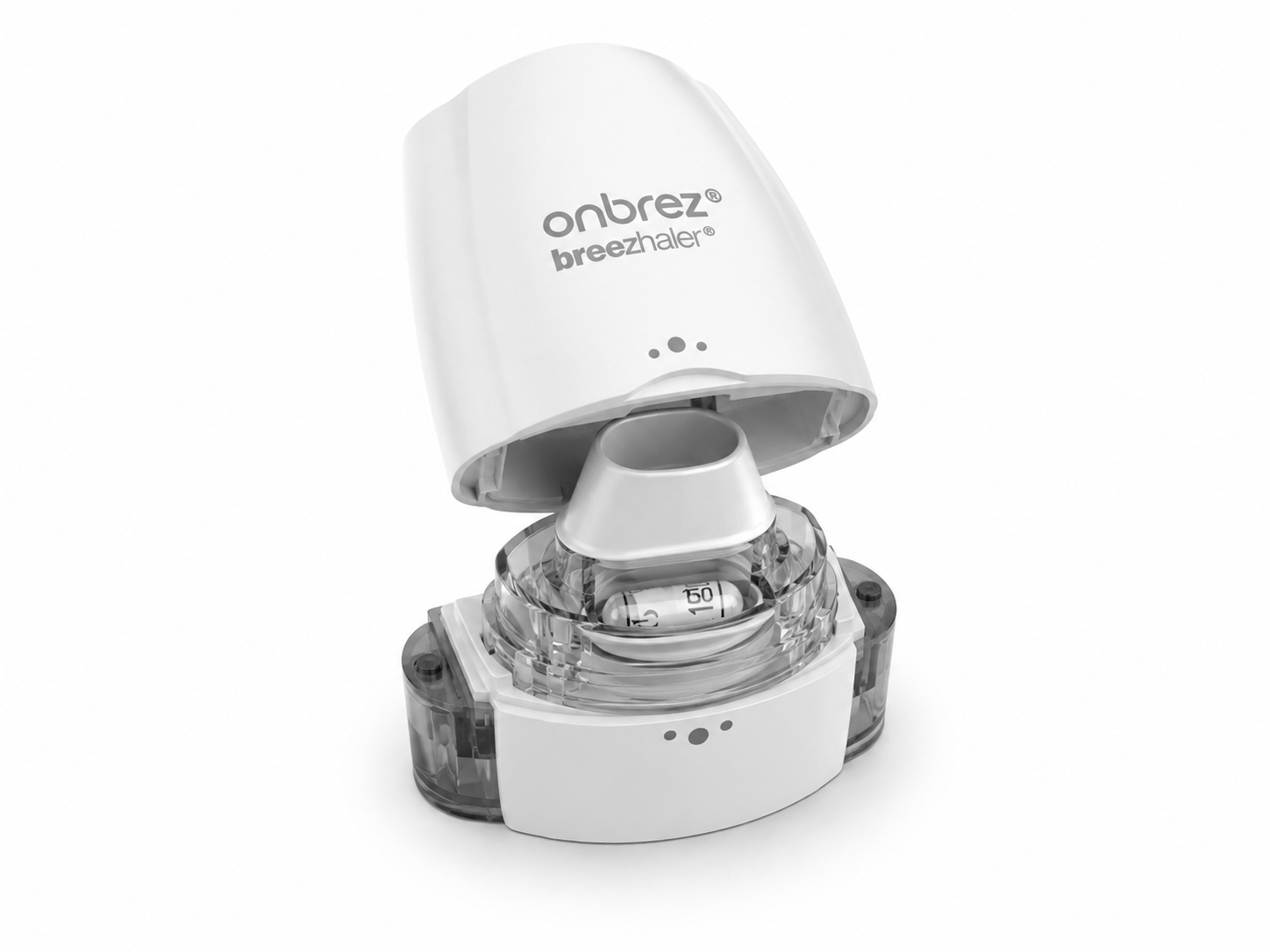
Breezhaler medicines are taken on a fixed schedule to keep the airways open over time. They are not rescue medicines and extra doses must not be taken during an attack. The capsules are for inhaling only — never swallow them. Keep your separate blue reliever with you.
Examples of this type
Different medicines come in this device. Common examples include:
- Onbrez Breezhaler (indacaterol)
- Seebri Breezhaler (glycopyrronium)
- Ultibro Breezhaler (indacaterol / glycopyrronium)
- Enerzair Breezhaler (indacaterol / glycopyrronium / mometasone)
- Atectura Breezhaler (indacaterol / mometasone)
Brand names are examples only and availability changes — always go by the name on your own inhaler and your prescriber's instructions.
How to use it — step by step
Getting the best from it
- The rattle confirms a good inhalation.1,2
- Only load a capsule immediately before use; never swallow the capsules.
- A second breath from the same capsule is often needed to empty it.
Looking after your inhaler
Wipe the mouthpiece and chamber with a dry cloth; keep it dry. Store capsules in their blister until use.
Most people lose some accuracy over time.3,4 We can check your inhaler technique at your appointment.
References & evidence base
- National Asthma Council Australia. Inhaler technique for people with asthma or COPD. Information paper for health professionals. Melbourne: National Asthma Council Australia, 2026.
- Australian Commission on Safety and Quality in Health Care. Inhaler technique — device-specific checklists. Sydney: ACSQHC, 2020.
Further reading
- Sanchis J, Gich I, Pedersen S; ADMIT Group. Systematic review of errors in inhaler use: has patient technique improved over time? Chest 2016;150(2):394–406.
- Usmani OS, Lavorini F, Marshall J, et al. Critical inhaler errors in asthma and COPD: a systematic review of impact on health outcomes. Respir Res 2018;19(1):10.
References are numbered in citation order (Vancouver/BMJ style) and were current at the time of writing. Always follow the leaflet for your specific device and your prescriber's instructions.
Everything starts with an assessment — your symptoms, breathing, exercise tolerance and daily function measured properly, so what follows is built on your lungs rather than an average.
Corrections: If something on this page is wrong, out of date or unclear, we want to know. Email reception@inspireclinic.au with the page name and what you believe is incorrect. Substantive corrections are made promptly, and the guide’s version and last-updated date are changed to reflect it.