Ahpra registration PHY0002298174
How these guides are written and reviewed →
The position you sit or lie in changes how your lungs work. Physiotherapists use this in two ways: to let gravity help drain mucus from a particular part of the lung, and to improve breathing and oxygen levels. It's simple, drug-free and can be done at home — but the right position depends on the person and the problem, so it should be set up with your physiotherapist first.
Two reasons position matters
1. Gravity-assisted drainage — helping the chest clear
Each part of the lung drains best when that part is uppermost, so gravity can move secretions towards the larger airways where they can be coughed or cleared. This is postural drainage, and it's used alongside airway-clearance techniques rather than on its own — combined with breathing control and huffing/coughing. See Principles of Airway Clearance and ACBT.1
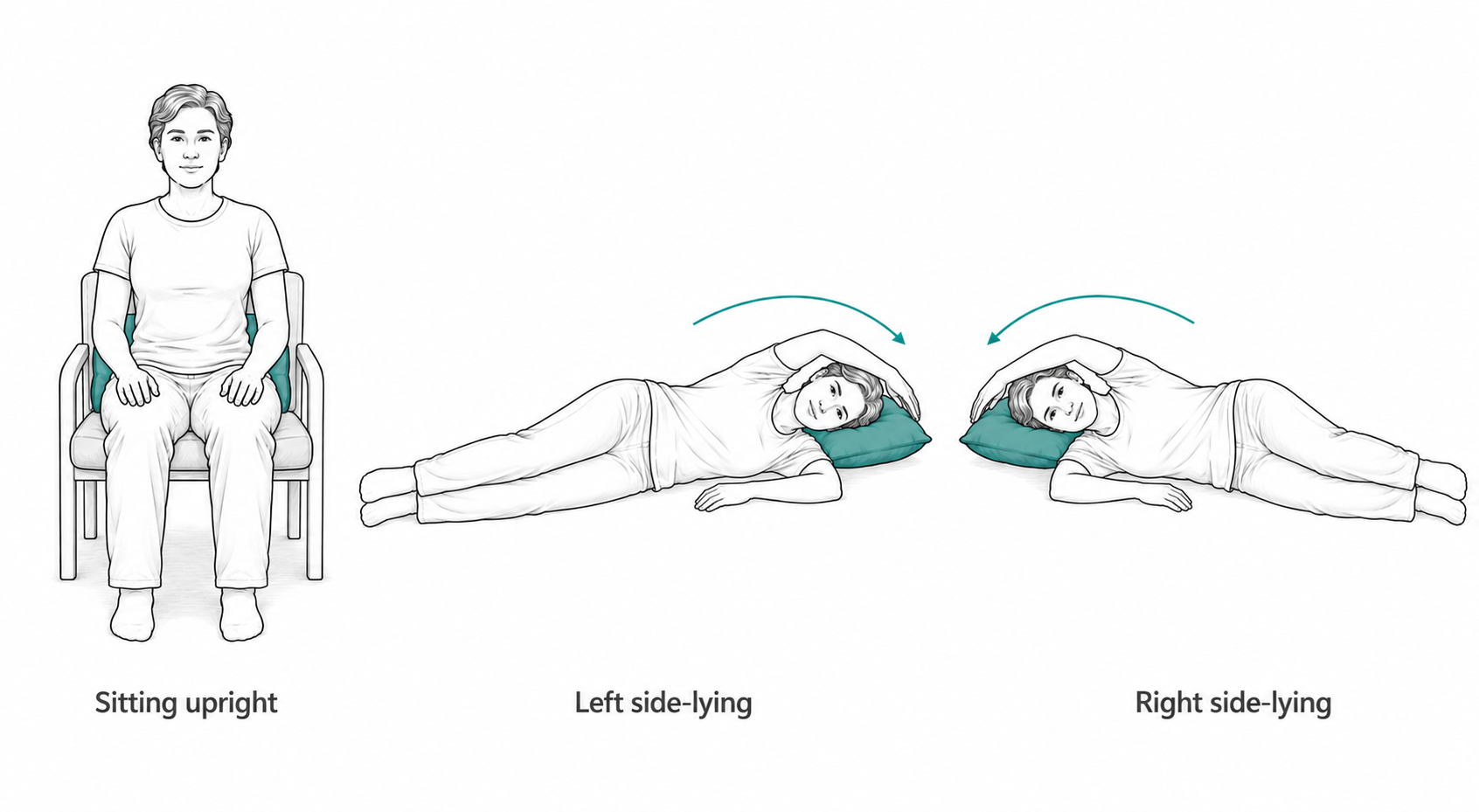
Positions are chosen to target the affected lung segments — for example, sitting upright or leaning to drain the upper parts, or side-lying to drain one lung. Today, modified positions (without a steep head-down tilt) are usually preferred and are just as effective for most people, while being far safer and more comfortable.
2. How position changes your breathing
Position also changes how air and blood are distributed through the lungs, which affects oxygen levels:2
- Upright is best for lung volume. Sitting or standing lets the diaphragm drop and opens up the lower lungs, increasing the volume of air they hold — which is why breathless people naturally sit up.
- Air and blood both flow more to the lowest part of your lungs. In an adult, both air and blood flow preferentially to the lower, dependent parts of the lung. Placing the healthier lung down (side-lying) often improves oxygen levels, because that well-functioning lung then receives the most blood flow. (In infants the opposite is true — the uppermost lung ventilates best.)
- Positions of ease — leaning forward onto a table or pillows, or high side-lying — reduce the work of breathing and ease breathlessness. See Breathlessness and Low Oxygen & Ventilation.
A steep head-down (Trendelenburg) position is not suitable for everyone and is often avoided. Tell your physiotherapist if you have any of these:
- reflux or heartburn;
- recent surgery;
- breathlessness lying flat, or heart failure;
- high blood pressure, a recent stroke or raised pressure in the head;
- coughing up blood;
- a risk of aspiration (food, drink or stomach contents going down into the lungs).
Leave at least an hour after a meal. Modified, flatter positions are used instead. Always have positions set up with your physiotherapist before doing them at home.
How we use it & at home
Your physiotherapist matches positions to your lungs and your comfort, teaches you to combine them with breathing and huffing, and gives you a simple routine to use during a flare-up or as daily maintenance. Keep sessions comfortable, stop if you feel unwell or very breathless, and clear secretions with a controlled huff rather than hard coughing. See Your Plan for Managing Your Condition.3
References & evidence base
- Main E, Denehy L, editors. Cardiorespiratory physiotherapy: adults and paediatrics. 5th ed. Edinburgh: Elsevier, 2016.
- Hough A. Hough’s cardiorespiratory care: an evidence-based, problem-solving approach. 5th ed. Edinburgh: Elsevier, 2017.
- Bott J, Blumenthal S, Buxton M, et al. Guidelines for the physiotherapy management of the adult, medical, spontaneously breathing patient. Thorax 2009;64(Suppl 1):i1–i52.
References are numbered in citation order (Vancouver/BMJ style) and were current at the time of writing. Guidelines are living documents — verify against the latest version before clinical use.
More than one of our services applies here, and which combination suits you depends on what your assessment shows.
Corrections: If something on this page is wrong, out of date or unclear, we want to know. Email reception@inspireclinic.au with the page name and what you believe is incorrect. Substantive corrections are made promptly, and the guide’s version and last-updated date are changed to reflect it.