Ahpra registration PHY0002298174
How these guides are written and reviewed →
A nebuliser turns liquid medicine into a fine mist you breathe in over a few minutes. The medicine may be a reliever such as salbutamol (Ventolin®), or hypertonic saline (salty water that thins sticky mucus, such as MucoClear®). It is used when medicine needs to be delivered as a larger, slow dose — most often to help loosen and clear sticky secretions, to open the airways, or to deliver inhaled antibiotics. For most everyday preventer and reliever medicines an inhaler (puffer) is quicker and just as effective — your team will tell you when a nebuliser is the right tool.
What nebulised therapy is for
Nebulised therapy has three main jobs in cardiorespiratory care:1
- Airway hydration and mucus clearance — saline and hypertonic saline draw water into the airways and thin sticky mucus, making your airway clearance more productive.
- Opening the airways — nebulised relievers (bronchodilators) can be used before clearance or during a flare-up.
- Treating or suppressing infection — some people with chronic conditions such as bronchiectasis or cystic fibrosis use nebulised antibiotics long-term.
Medicines commonly nebulised at home
| Type | Examples | What it does |
|---|---|---|
| Saline & hypertonic saline | 0.9% saline; hypertonic saline 3% or 6% (e.g. PARI MucoClear®) | Hydrates the airways and thins mucus so it is easier to clear. Hypertonic saline is usually taken just before airway clearance. |
| Bronchodilators (relievers) | Salbutamol; ipratropium | Opens the airways. Often given before hypertonic saline to reduce the chance of tightness or cough. |
| Mucolytics | Dornase alfa (Pulmozyme) — in cystic fibrosis | Breaks down thick, very sticky mucus. |
| Inhaled antibiotics | Colistin; tobramycin; aztreonam | Delivers antibiotic directly to the lungs in chronic infection. Always taken last in a session. |
Only nebulise medicines that have been specifically prescribed for nebulising. Never put a medicine into a nebuliser unless your prescriber has told you to.2
Is there a difference between ordinary and hypertonic saline?
Most people have met isotonic saline — 0.9% sodium chloride. Its salt content is about the same as that already found in your cells and body fluids, so inhaling it mainly moistens the airways.
Hypertonic saline has a higher salt content than isotonic saline. That higher concentration draws water out of the airway wall and into the mucus itself, which thins and loosens it — helping to clear the lungs when mucus has built up.1
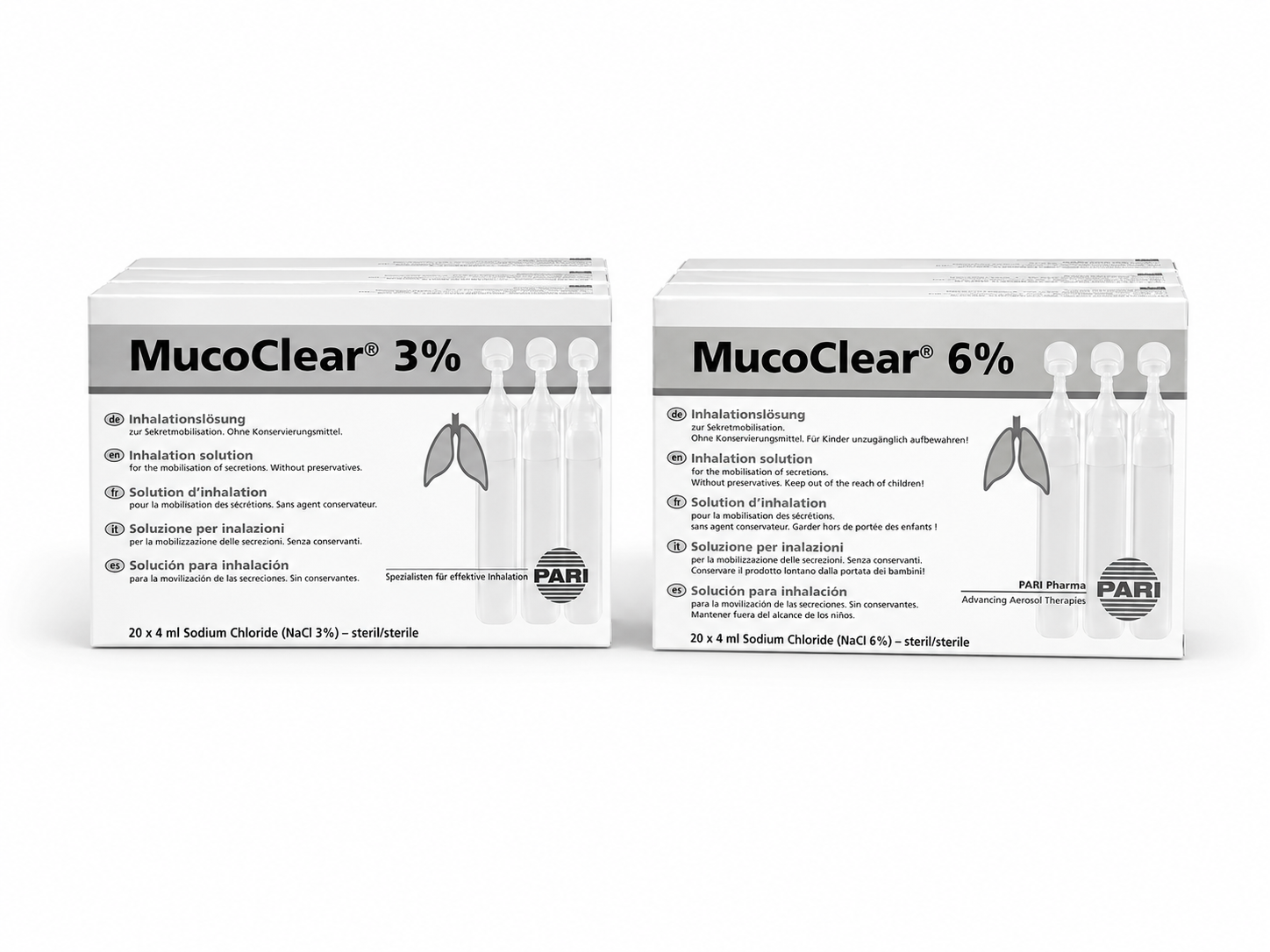
MucoClear® 3% versus 6% — what is the difference?
Both strengths are sterile salt-water solutions that draw water into the airways to loosen thick mucus. The only difference is the salt concentration.3
- MucoClear® 3% is gentler. It causes less coughing, throat irritation and chest tightness, so it is often the starting strength and the usual step down when 6% is not tolerated.
- MucoClear® 6% is stronger and generally thins mucus better, but it is more likely to cause coughing or tightness, especially in people with twitchy airways.
Because the stronger solution can provoke bronchospasm (a sudden tightening of the airways), a reliever (bronchodilator) is usually taken first, and your physiotherapist may trial 6% under supervision before you use it at home. Which strength suits you is decided individually, based on how thick your secretions are, how well you tolerate it, and your response over time — so always use the strength you have been prescribed.
Where it fits in your day
When you use several therapies, order matters. A typical sequence is:4
Nebulised therapy usually sits within a set morning and evening routine alongside your reliever, airway clearance and inhalers. See your plan for managing your condition for the full daily sequence.
Using a nebuliser safely
- Wash and dry your hands, and use a clean, dry medication cup each time.
- Sit upright and relaxed; breathe normally with an occasional slow, deep breath. A session usually takes about 5–10 minutes, until the misting stops or sputters.
- Rinse your mouth after steroid or antibiotic medicines.
- Hygiene is essential — a dirty nebuliser can grow bacteria and cause a chest infection. Rinse and dry all medication parts after every use, and clean thoroughly as the manufacturer directs.
See the dedicated device guide for cleaning, charging and troubleshooting.
References & evidence base
- Elkins MR, Bye PTP. Mechanisms and applications of hypertonic saline. J R Soc Med 2011;104(Suppl 1):S2–S5.
- Australian Medicines Handbook. Adelaide: Australian Medicines Handbook Pty Ltd, 2026.
- Wark P, McDonald VM. Nebulised hypertonic saline for cystic fibrosis. Cochrane Database Syst Rev 2018;(9):CD001506.
- Hill AT, Sullivan AL, Chalmers JD, et al. British Thoracic Society guideline for bronchiectasis in adults. Thorax 2019;74(Suppl 1):1–69.
References are numbered in citation order (Vancouver/BMJ style) and were current at the time of writing. Guidelines are living documents — verify against the latest version before clinical use. For drug-specific detail, including full product information, consult MedsInfo.
More than one of our services applies here, and which combination suits you depends on what your assessment shows.
Corrections: If something on this page is wrong, out of date or unclear, we want to know. Email reception@inspireclinic.au with the page name and what you believe is incorrect. Substantive corrections are made promptly, and the guide’s version and last-updated date are changed to reflect it.